
Millar, Seán R  ORCID: https://orcid.org/0000-0003-4453-8446 and Mongan, Deirdre ORCID: https://orcid.org/0000-0003-3616-4253
(2026)
Irish findings from the European Web Survey on Drugs 2024.
Drugnet Ireland,
Issue 96, October 2026,
pp. 20-26.
| Preview | Title | Contact |
|---|---|---|
|
PDF (Drugnet Ireland 96)
2MB |
Surveys on drug use among the general population have been conducted in Ireland six times. However, although these surveys provide prevalence rates regarding drug use, they can only collect robust information on patterns of use for the more commonly used drugs, such as cannabis. They do not collect data from a sufficiently large sample of people who use drugs to provide reliable information on patterns of use for less frequently used drugs such as ecstasy, amphetamines, and emerging substances.
The European Union Drugs Agency (EUDA) has developed the European Web Survey on Drugs (EWSD) in order to collect data from a wide range of people who use drugs. In 2024, Ireland participated in the EWSD for the second time. The rationale for this was to generate new data on patterns of drug use, as set out in Action 5.1.45 of the Irish Government’s national drugs strategy.
The data collected provided information on:
- drug use and frequency of drug use by sex, age, and drug type
- location of drug use
- motivations for using drugs
- the main sources used to obtain drugs
- drug use in nightlife and festival settings
- drug information and education on drugs.
The 2024 Irish EWSD was an online, convenience, non-probability survey. The study population included people aged 18 years and over who lived in Ireland and who had used drugs in the previous 12 months. Data collection commenced on 21 May 2024 and finished on 14 July 2024, and was managed centrally by the EUDA. Participants accessed the questionnaire on EUSurvey, the European Commission’s official survey management system. A total of 3,156 people clicked on the link and began the survey. However, 346 did not complete the consent questions and therefore could not continue to the survey; 38 were not living in Ireland; and 366 had not used illicit drugs in the past year, and their responses were excluded from the analysis. This gave a final sample of 2,406 for analysis, of whom 63.1% were male and 35.7% were female. The median age of respondents was 30 years. The main Irish findings from the EWSD report1 are discussed throughout the rest of this article.
Last-year and last-month drug use
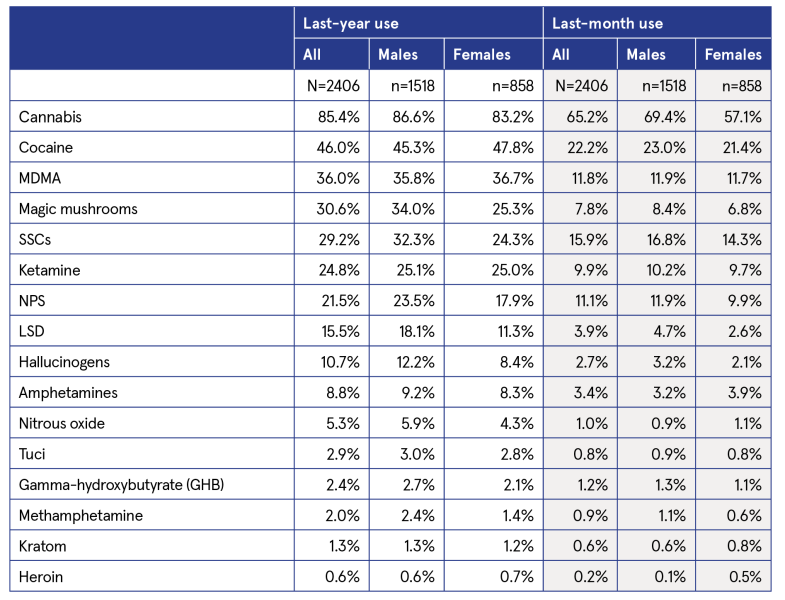
Last-year and last-month use of each drug is presented in Table 1. It should be noted that the data presented here do not provide population prevalence estimates, and given the recruitment strategy employed, we cannot assume they are representative of the drug-using population in Ireland. The most commonly used drug in the last year was cannabis (85.4%), followed by cocaine (46.0%), 3,4-methylenedioxymethamphetamine (MDMA) (36.0%), magic mushrooms (30.6%), semi-synthetic cannabinoids (SSCs) (29.2%), and ketamine (24.8%). For most drugs, the proportion of males and females reporting last-year use were similar; however, males were much more likely than females to use magic mushrooms, SSCs, and lysergic acid diethylamide (LSD). Those aged 18–24 years were more likely than older age groups to report last-year use of SSCs, ketamine, new psychoactive substances (NPS), and nitrous oxide.
Table 1: Last-year and last-month drug use among respondents, by sex
Source: EWSD (2025)
Polydrug use
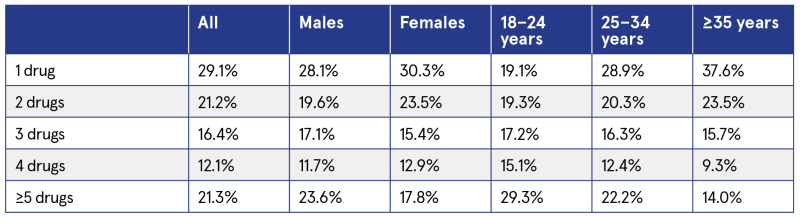
Concurrent polydrug use (defined in this survey as the use of two or more different drugs, excluding alcohol, in the last year) was reported by 70.9% of respondents, with 21.3% reporting the use of at least five different drugs in the last year. Males were more likely than females to have used five or more drugs (23.6% versus 17.8%). The likelihood of using five or more drugs decreased with increasing age, going from 29.3% among 18–24-year-olds to 14.0% among those aged 35 years and over (Table 2).
Table 2: Number of drugs used in the last year, by sex and age group
Source: EWSD (2025)
Frequency of drug use
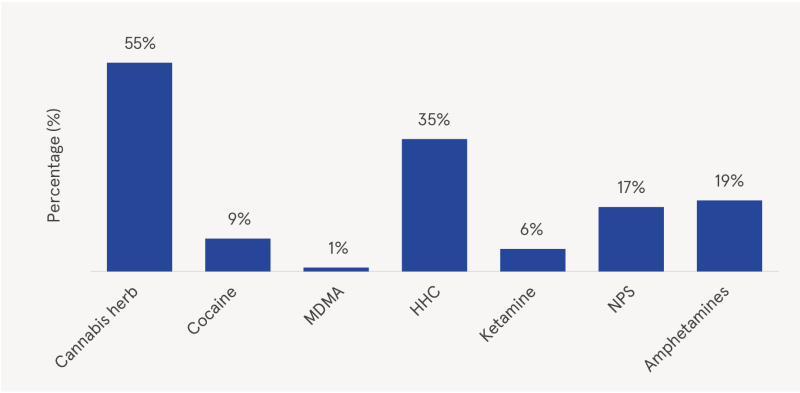
Over one-half of those who reported last-year cannabis herb use stated they used it on a weekly basis (see Figure 1). In comparison, just 1.1% of MDMA users and 6.0% of ketamine users reported weekly use.
Location of drug use
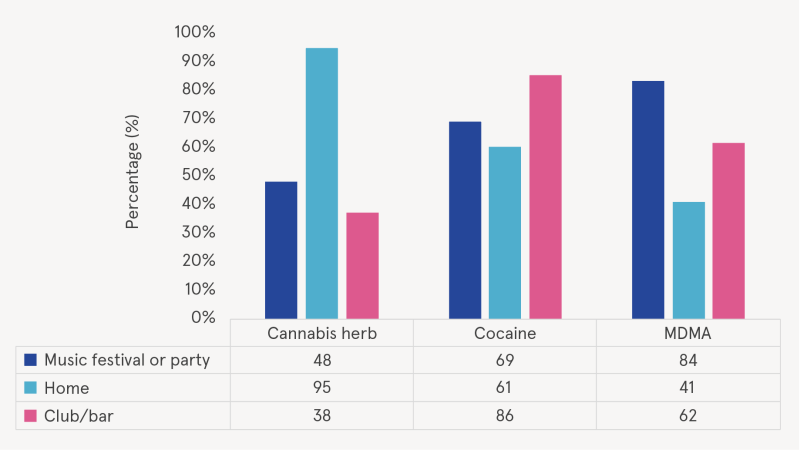
The locations in which drugs were used varied by drug type (see Figure 2). Cannabis herb was most likely to be used at home, while MDMA was most likely to be used at a music festival or party, and cocaine was most likely to be used in a club or a bar. Cannabis herb was the drug least likely to be used at a music festival or party or in a club or bar, while it was the drug most likely to be used at home.
Motivations for using drugs
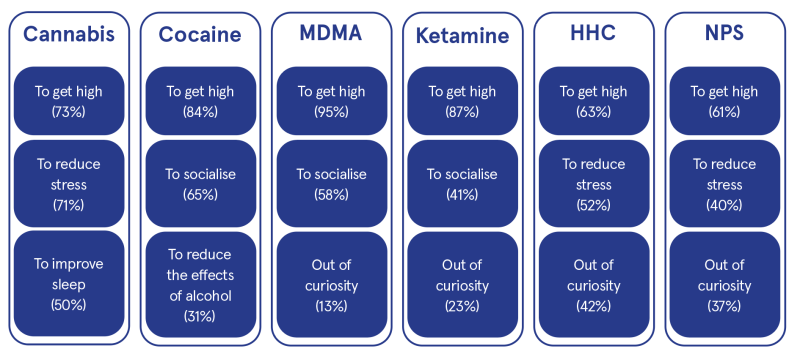
There were differences in respondents’ motivations for using each drug (see Figure 3). The predominant reasons for using stimulant-type drugs such as cocaine or MDMA were to get high or to socialise. Another common reason for using cocaine was to reduce the effect of alcohol. Respondents cited a wide range of reasons for using cannabis. While 73% used cannabis to get high, 71% used it to reduce stress, and 50% used it to improve sleep. Similar results were observed for hexahydrocannabinol (HHC): while 62.9% used HHC to get high, 51.9% used it to reduce stress.
How drugs are sourced
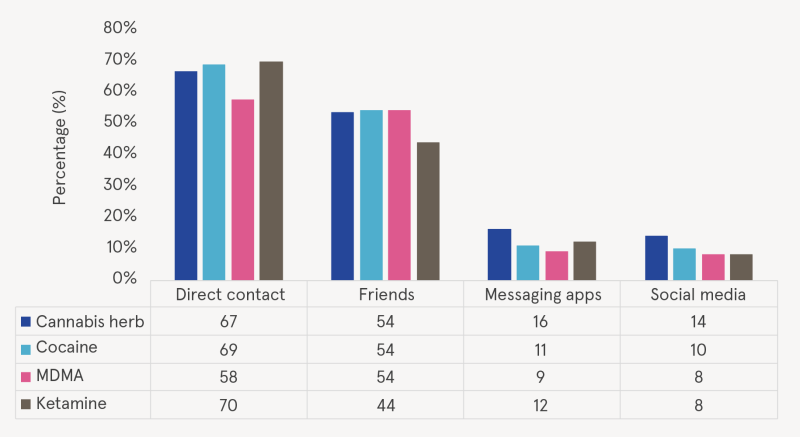
Respondents were asked how they sourced each drug they used (see Figure 4). Users of cannabis herb and MDMA were most likely to state that they mostly bought their products themselves. Those who used cocaine and ketamine were most likely to state that they got these drugs for free. The main method of purchasing each drug type was through direct contact with a dealer. Ketamine users were most likely to buy ketamine through direct contact with their dealer and were less likely than other drug users to purchase from friends. MDMA users were least likely to use either messaging apps or social media to purchase their drugs. The proportion of those using either social media or messaging apps to purchase drugs was low across all drug types.
Drug use in nightlife and festival settings
Most respondents used drugs in nightlife or festival settings, with polydrug use particularly prevalent among festival-goers. On the last occasion on which respondents used drugs in nightlife settings, 23.8% used three substances (including alcohol), 8.1% used four substances, and 6.0% used five or more substances. On the last occasion on which respondents used drugs at festivals, 23.5% used three substances, 18.1% used four substances, and 21.9% used five or more substances. One in five respondents had seen harm reduction information from the HSE’s Safer Nightlife Programme, with one in three of these stating that the harm reduction information they received had an impact.
Source: EWSD (2025)
Figure 1: Frequency of drug use reported in the 2024 Irish EWSD
Source: EWSD (2025)
Figure 2: Location of drug use reported in the 2024 Irish EWSD
Source: EWSD (2025)
Figure 3: Top three reasons for using drugs, by drug type
Note: Respondents could select more than one option
Source: EWSD (2025)
Figure 4: Methods used to buy drugs among those who bought drugs in the last year, by drug type
Note: Respondents could select more than one option
Drug information and education
Three-quarters of respondents had not received a structured drug awareness intervention in school. The primary source of drug information was personal research online while the main source of harm reduction information was through Google searches. Approximately one-half of respondents had applied harm reduction measures in the previous year.
Conclusions
One of the main findings of this survey is the emergence of SSCs (particularly HHC) onto the Irish drug market. While 14% of the EWSD sample from the 24 participant European Union (EU) countries and Norway reported last-year SSC use, 29% of Irish respondents reported last-year SSC use, which may be due to SSCs being legal to purchase in Ireland during the data collection phase of this survey. One-third of respondents had used HHC in the previous year, which is considerable given that HHC was only formally identified in Europe in 2022 and in Ireland in early 2023. Polydrug use is also a predominant feature of Irish drug use, with 70.9% of respondents reporting the use of two or more drugs (excluding alcohol) in the last year. Similar to the findings of the 2021 Irish EWSD, in 2024 cocaine was the second most commonly used drug, with 46.0% of respondents reporting last-year use. While this is slightly lower than the proportion reporting cocaine use in Ireland in 2021 (49%), it is considerably higher than the rate of 29% reported in 2024 by the entire EWSD sample reporting last-year cocaine use for the EU and Norway.2 The continued high rate of cocaine use in Ireland is not surprising and reflects research on cocaine use and cocaine-related harm from other Irish data sources that demonstrate sustained high levels of cocaine use and cocaine-related harm since 2014.3
The report authors note that when interpreting Irish results from the EWSD, it is important to consider them in the context of the survey’s strengths and limitations. The Irish EWSD had a very comprehensive and effective recruitment campaign, which utilised many different online channels and achieved a valid sample of 2,406 respondents. This ensured a sufficient number of respondents to adequately analyse patterns of drug use, including analyses on drugs that are less prevalent in Ireland. However, the sample achieved in the current survey was considerably lower than the sample of 5,796 achieved in the 2021 survey. Notwithstanding this, the Irish EWSD is a useful tool for collecting information on patterns of drug use from a large number of people both quickly and cheaply.
1 Mongan D, Killeen N, Keenan E, Millar SR and Galvin B (2026) European Web Survey on Drugs 2024: Irish results. Dublin: Health Research Board. https://www.drugsandalcohol.ie/45556/
2 European Union Drugs Agency (2025) European Web Survey on Drugs 2024: top-level findings, 24 EU countries and Norway. Lisbon: European Union Drugs Agency. https://www.drugsandalcohol.ie/47092/
3 Mongan D, Millar SR, Carew AM, et al. (2025) Trends in cocaine use and cocaine-related harms in Ireland: a retrospective, multi-source database study. BMC Public Health, 25(1): 2285. https://www.drugsandalcohol.ie/43633/
A Substance use and dependence > Prevalence > Substance use behaviour
B Substances > Cannabis / Marijuana
B Substances > Hallucinogens / Psychedelics > LSD (Lysergic acid diethylamide)
B Substances > Hallucinogens / Psychedelics > Mushrooms (psilocybin / Amanita muscaria /Psilocybe)
B Substances > Inhalants and solvents > Nitrous oxide (laughing gas)
B Substances > CNS stimulants > Amphetamines
B Substances > CNS stimulants > Methamphetamine
B Substances > CNS stimulants > MDMA / Ecstasy
B Substances > Cocaine
B Substances > Cocaine > Crack cocaine
B Substances > Opioids (opiates) > Heroin (diacetylmorphine / diamorphine)
B Substances > New (novel) psychoactive substances
B Substances > New (novel) psychoactive substances > Aminoindanes / Arylalkylamines / Arylcyclohexylamines > Ketamine
B Substances > New (novel) psychoactive substances > Plants and extracts > Kratom (Mitragyna speciosa)
B Substances > New (novel) psychoactive substances > Other novel substances > GHB / GBL (Gamma hydroxybutyric / Gamma butyrolactone)
F Concepts in psychology > Motivation
G Health and disease > Substance use disorder (addiction) > Multiple / concurrent substance use (Poly-drug)
L Social psychology and related concepts > Social context
L Social psychology and related concepts > Social context > Social, cultural or entertainment event
L Social psychology and related concepts > Availability, accessibility, and supply
VA Geographic area > Europe > Ireland
Repository Staff Only: item control page