
Millar, Seán R  ORCID: https://orcid.org/0000-0003-4453-8446
(2026)
Non-fatal drug-related hospital admissions in Ireland, 2025.
Drugnet Ireland,
Issue 96, October 2026,
pp. 41-46.
| Preview | Title | Contact |
|---|---|---|
|
PDF (Drugnet Ireland 96)
2MB |
The Hospital In-Patient Enquiry (HIPE) scheme is a computer-based system that is managed by the Economic and Social Research Institute (ESRI) in association with the Department of Health and the Health Service Executive (HSE). It collects demographic, medical, and administrative data on all admissions, discharges, and deaths from acute general hospitals in Ireland. Each HIPE discharge record represents one episode of care; each discharge of a patient, whether from the same or a different hospital, with the same or a different diagnosis, gives rise to a separate HIPE record. The scheme therefore facilitates analysis of hospital activity rather than of the incidence of disease. HIPE does not record information on individuals who attend emergency departments but are not admitted as inpatients. Monitoring of drug-related acute emergencies in the Irish context refers to all admissions for non-fatal overdoses to acute general hospitals in Ireland.
Drug-related emergencies: Non-fatal overdoses
Data extracted from the HIPE scheme were analysed in order to determine trends in non-fatal overdoses among patients who were discharged from Irish hospitals in 2025.1 There were 4,280 overdose cases in 2025, of whom 72 died in hospital. Only discharged cases are included in this analysis (N=4208). There was a noticeable increase in overdose cases during the peak years of the COVID-19 pandemic, with the number of discharged overdose cases in 2020 being the highest recorded since 2008. Since the end of the pandemic, the number of overdose cases has decreased, with the number of discharged overdose cases in 2025 being the lowest recorded since 2016 (see Figure 1).
Sex of overdose cases
Between 2015 and 2025, there were more overdose cases among women than men, with women accounting for 2,335 (55.5%) of all non-fatal overdose cases in 2025 (see Figure 2).
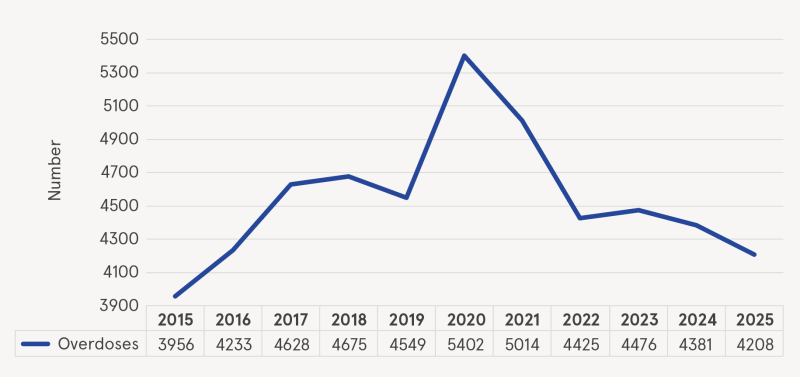
Source: HIPE, Healthcare Pricing Office (2026)
Figure 1: Number of non-fatal overdose cases admitted to Irish hospitals, by year, 2015–2025
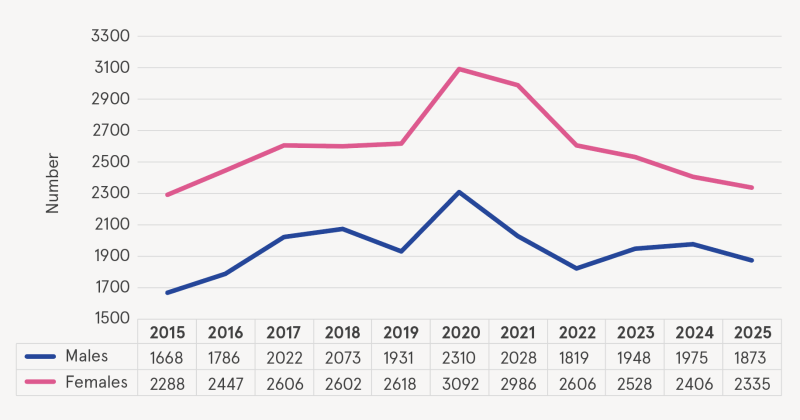
Source: HIPE, Healthcare Pricing Office (2026)
Figure 2: Number of non-fatal overdose cases admitted to Irish hospitals, by year and sex, 2015–2025
Age group
Between 2015 and 2020, there was a general increase in the number of non-fatal overdose cases in all age groups. As noted in previous years, the incidence of overdose cases in 2025 peaked in the 15–24 years age group (see Figure 3). In 2025, 32.1% of cases were aged under 25 years.
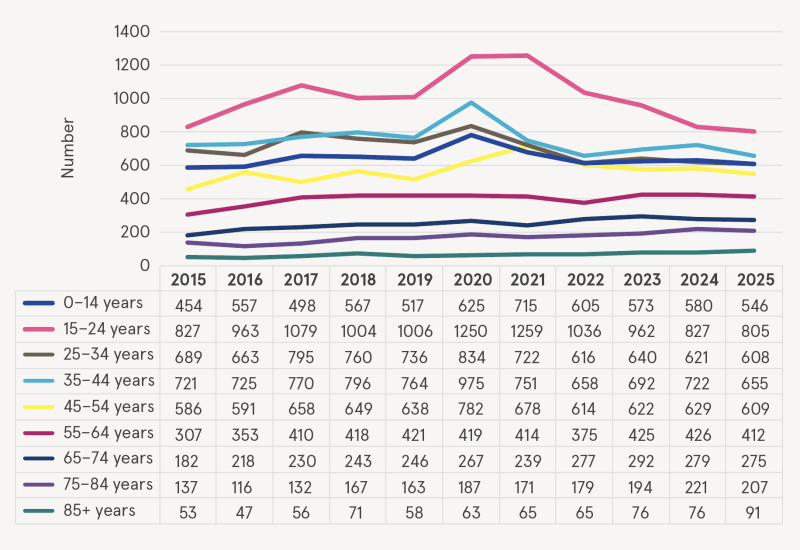
Source: HIPE, Healthcare Pricing Office (2026)
Figure 3: Non-fatal overdose cases admitted to Irish hospitals, by year and age group, 2015–2025
Toxicology of drug-related acute emergencies
Table 1 presents the positive findings per category of drugs and other substances involved in all cases of overdose in 2025. Non-opioid analgesics were present in 1,394 cases. Paracetamol is included in this drug category and was present in 1,188 cases in 2025. Benzodiazepines and psychotropic agents were present in 698 and 1,000 cases, respectively. There was evidence of alcohol consumption in 207 cases in 2025. Cases involving alcohol are included in this analysis only when alcohol was used in conjunction with another substance.
Table 1: Categories of drugs involved in non-fatal overdose cases admitted to Irish hospitals, 2025
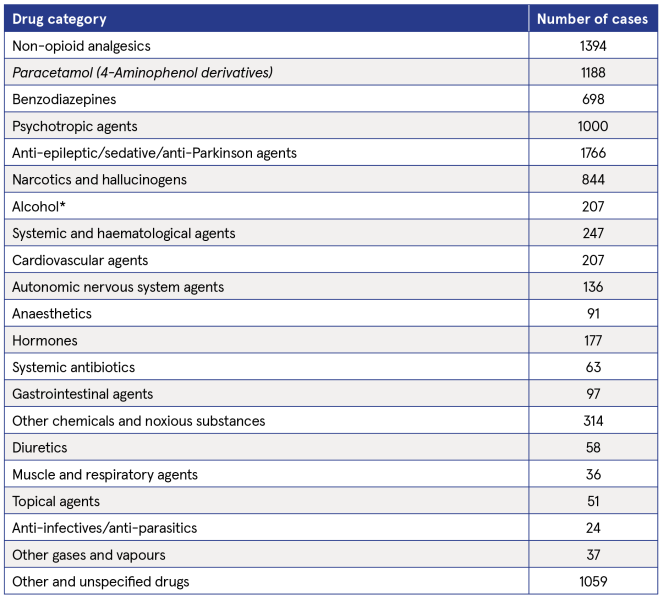
Source: HIPE, Healthcare Pricing Office (2026)
Note: The sum of positive findings is greater than the total number of cases, as some cases involved more than one drug or substance.
* Alcohol was only included for cases where any code from any of the other drug categories in this table was also reported.
Overdoses involving narcotics or hallucinogens
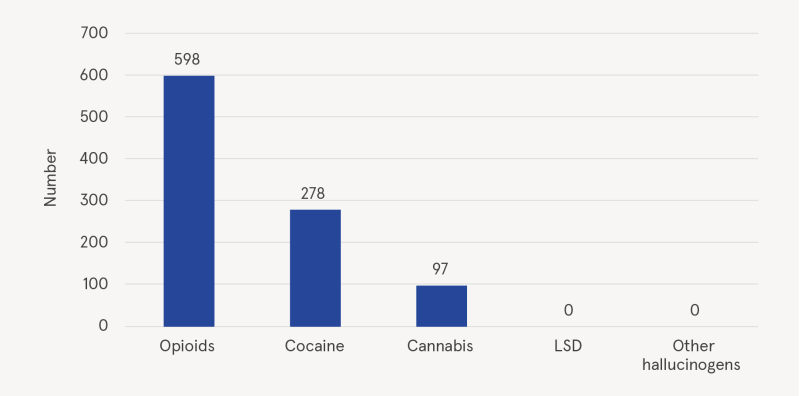
Figure 4 shows positive findings of illicit substances among non-fatal overdose cases in 2025. Opioids were used in 14.2% (n=598) of cases, cocaine in 6.6% (n=278) of cases, and cannabis in 2.3% (n=97) of cases in 2025. No (or five or fewer) overdose cases involving lysergic acid diethylamide (LSD) or other hallucinogens were recorded.
Source: HIPE, Healthcare Pricing Office (2026)
Figure 4: Narcotics and hallucinogens involved in non-fatal overdose cases admitted to Irish hospitals, 2025
Source: HIPE, Healthcare Pricing Office (2026)
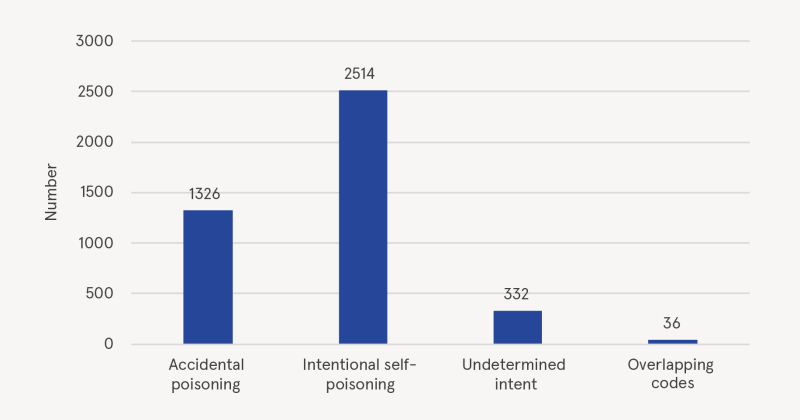
Figure 5: Non-fatal overdose cases admitted to Irish hospitals, classified by intent, 2025
Overdoses classified by intent
For 59.7% (n=2514) of non-fatal overdose cases in 2025, the overdose was classified as intentional (see Figure 5). For 7.9% (n=332) of cases, classification of intent was not clear.
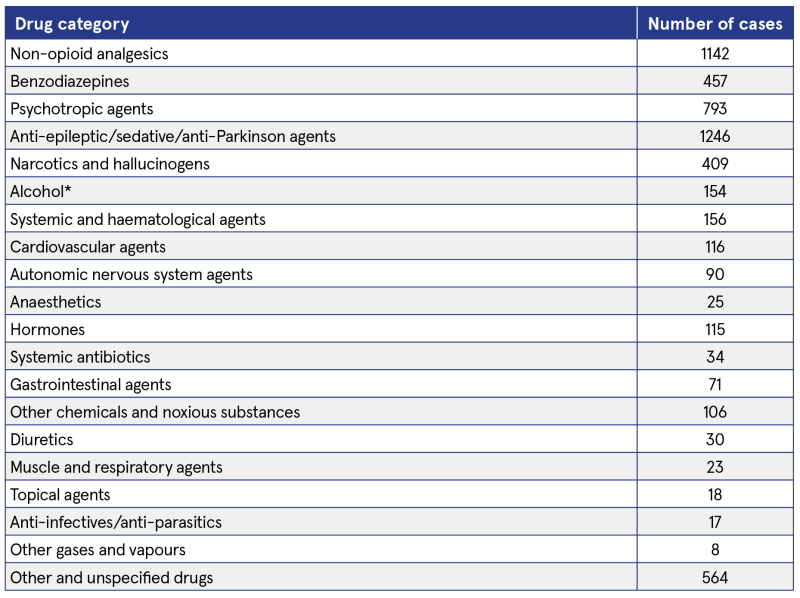
Table 2 presents the positive findings per category of drugs and other substances involved in non-fatal cases of intentional self-poisoning in 2025 (n=2514). In 2025, non-opioid analgesics were involved in 1,142 such cases, benzodiazepines in 457 cases, and psychotropic agents in 793 cases.
Table 2: Categories of drugs involved in non-fatal intentional self-poisoning cases admitted to Irish hospitals, 2025
Source: HIPE, Healthcare Pricing Office (2026)
Note: As some discharges may be included in more than one drug category, the total count in this table exceeds the total number of discharges.
* Alcohol was only included for cases where any code from any of the other drug categories in this table was also reported.
1 For further information on HIPE data, visit the Healthcare Pricing Office website: https://www.hpo.ie/
B Substances > Substances in general
B Substances > Alcohol
B Substances > Hallucinogens / Psychedelics
B Substances > Hallucinogens / Psychedelics > LSD (Lysergic acid diethylamide)
B Substances > Cocaine
B Substances > Opioids (opiates)
B Substances > New (novel) psychoactive substances > Benzodiazepines
E Concepts in biomedical areas > Medical substance > Over the counter drug (medicine / medication)
E Concepts in biomedical areas > Medical substance > Prescription drug (medicine / medication)
E Concepts in biomedical areas > Pharmacology and toxicology
F Concepts in psychology > Behaviour > Self-destructive behaviour / self-harm > Suicidal behaviour / suicide
G Health and disease > Substance use disorder (addiction) > Drug use disorder > Drug intoxication > Poisoning (overdose)
J Health care, prevention, harm reduction and treatment > Health care programme, service or facility > Hospital
VA Geographic area > Europe > Ireland
Repository Staff Only: item control page