
Kelleher, Cathy  ORCID: https://orcid.org/0000-0002-1754-0244 and Riordan, Fiona
(2026)
Deaths among people who were homeless at time of death in Ireland, 2022.
Drugnet Ireland,
Issue 95, July 2026,
pp. 20-24.
ORCID: https://orcid.org/0000-0002-1754-0244 and Riordan, Fiona
(2026)
Deaths among people who were homeless at time of death in Ireland, 2022.
Drugnet Ireland,
Issue 95, July 2026,
pp. 20-24.
| Preview | Title | Contact |
|---|---|---|
|
PDF (Drugnet Ireland 95)
3MB |
The HRB has published its fourth report on deaths among people who were homeless at the time of death.1 The report describes deaths in 2022, with key trends for 2019–2022.
Background
The HRB collects data on all sudden and unexplained deaths among people who were homeless at the time of death, in order to better understand and prevent premature death among people who are homeless. The data are extracted from closed coronial files, using the methodology of the NDRDI, even if the deaths do not meet the standard NDRDI inclusion criteria. The NDRDI validates these data with the Dublin Region Homeless Executive through its Pathway Accommodation and Support System.
The deceased were considered as homeless if living in any of the following circumstances at the time of death:
- Homeless – without accommodation (sleeping rough)
- Homeless – temporary or crisis accommodation
- Homeless – severely substandard or highly insecure accommodation
- Homeless – unknown (no further details were available)
These criteria reflect international classifications that were adapted to reflect the types of accommodation available to people who are homeless in Ireland.
This study examined the number of deaths, cause of death, and characteristics of those who died for deaths between 2019 and 2022, where the coroner’s death investigation was complete.
Deaths in 2022
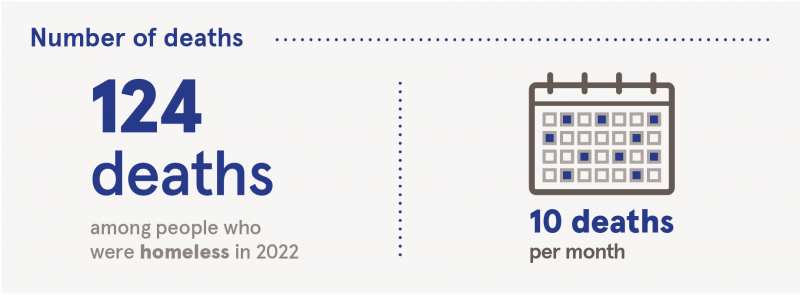
The HRB recorded 124 deaths among people who were homeless at time of death in 2022. This represents a 31% increase on the number of deaths in 2019, but a 7% decrease on 2021 deaths.
Demographic characteristics
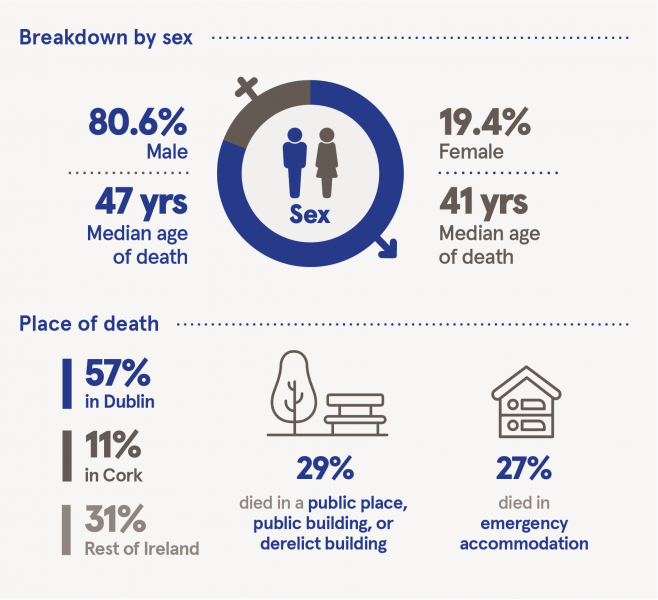
Eight in ten deaths were among males. The median age was 47 years for males, but younger for females at 41 years. In 2022, 85% of the deaths were in people aged under 60 years, compared with 13% of deaths in this age group in the general population.
Type of homelessness
In 2022, one in two (51%) people were in temporary or crisis accommodation, one in four (26%) were in severely substandard or highly insecure accommodation, and 16 people (13%) were sleeping rough (13%) prior to death. Most (57%) of the deceased were located in Dublin (city and county) and most (57%) incidents occurred there also.
Place of incident
The majority of incidents occurred in a private dwelling (31%), followed by a public place, building, or derelict building (29%), and specific accommodation for people who are homeless (26%). More than one in two (57%) people were alone at the time of the incident leading to death.
Substance use history
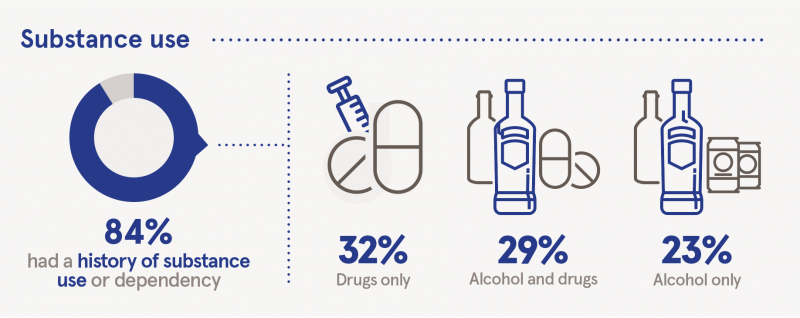
In 2022, a history of substance use was recorded for the majority (84%, 104) of the deceased. Of those, 62% had used drugs and 62% had alcohol dependency or problem use. Of those who used drugs, cocaine (72%) was the most common drug, followed by heroin (54%), alcohol (47%), and benzodiazepines (32%). One in five (22%, 27) people had ever injected drugs, while 10 people were injecting at the time of death. A history of previous overdose was recorded for 16 (19%) people.
In the month prior to death, almost three in ten (27%) people were in substance use treatment, most commonly opioid agonist treatment (21%), which was accessed by 36% of females and 19% of males.
In 2022, 20 people (16%) had no recorded history of substance use.
Other co-morbidities
One in five (20%) people had a history of bloodborne virus, most commonly hepatitis C. Mental health issues, present in 38% of people who were homeless at the time of death, were recorded for a higher proportion of females (49%) than males (36%).
Cause of death
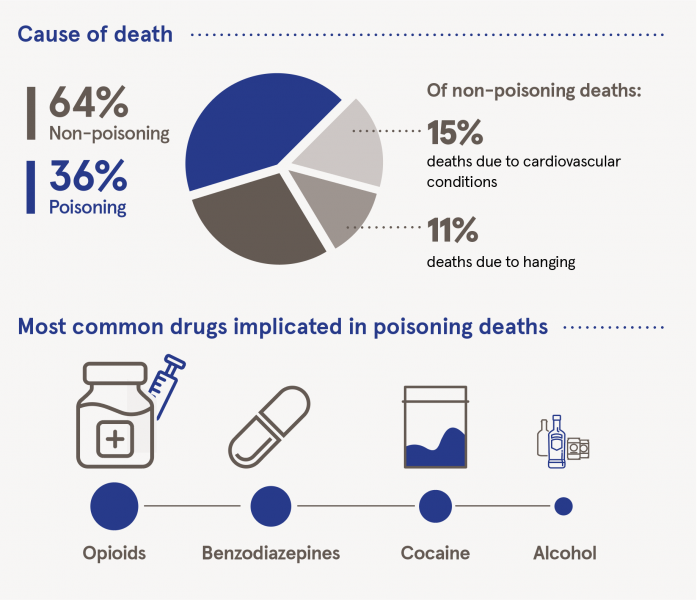
In 2022, 45 (36%) deaths were poisonings (drug overdose) and 79 (64%) were non-poisonings (i.e. due to all other causes, either traumatic or medical, irrespective of whether the coroner directly implicated drugs or alcohol in the death).
Poisonings
The median age of poisoning death was 43 years. Most (71%) poisonings involved more than one substance (polysubstance poisonings). Opioids (73%) were the most common drug group implicated, followed by benzodiazepines (58%), and cocaine (56%). Methadone (street or prescribed) (58%) was the most common specific drug implicated, and most (92%) methadone poisonings were polysubstance poisonings. Cocaine (56%) was the second most common poisoning drug after methadone and the most common poisoning drug among males. A known history of previous overdose was recorded in more than one in three (36%) poisoning deaths.
Non-poisonings
The median age of non-poisoning death was 48 years. Six in ten (61%) non-poisoning deaths had medical causes, while four in ten (39%) were traumatic deaths. The most common non-poisoning cause of death was cardiovascular conditions (15%), followed by falls (13%), hanging (11%) and respiratory conditions (11%).
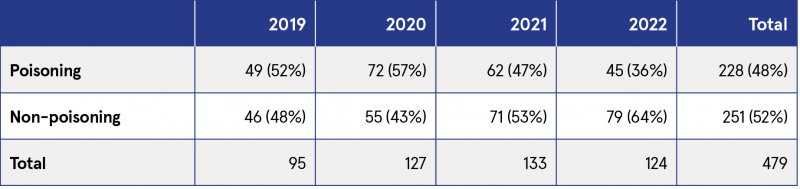
Table 1: Number of deaths and cause of death, 2019–2022
Key trends 2019–2022
In total, 479 deaths were recorded for 2019–2022 (Table 1). The number increased from 95 in 2019 to 124 in 2022, while the highest number recorded was in 2021 (133). The median age at death increased from 40 years to 46 years. Males were in the majority (eight in ten) in every year.
Over the period, almost six in ten (58%) people were residing in temporary or crisis accommodation, while one in five (20%) were sleeping rough. There was an increase in the number who were in severely substandard or highly insecure accommodation (from 17 in 2019 to 32 in 2022). Over the period, most (57%) of the deceased were homeless in Dublin (city and county).
A history of substance use was recorded for the majority (88%) of the deceased over the period. The number of people with a recorded history of alcohol dependence or problem use increased, by 46%. However, the number of people with no substance use history also increased, by 67%.
Non-poisoning deaths (52%, 251) were more common than poisoning deaths (48%, 228) over the period, mainly due to increases in non-poisonings in 2021 and 2022 (Table 1).
Opioids (78%) were the most frequently implicated drug group in poisoning deaths, followed by benzodiazepines (61%). Methadone was the most implicated specific drug, involved in more than one in two (53%) poisonings, most of which were polysubstance poisonings. After methadone, alprazolam (41%) and cocaine (40%) were the most common.
Over the period, polysubstance poisonings increased from 76% of deaths in 2019 to 89% in 2021, before decreasing to 71% in 2022.
The most common cause of non-poisoning death over the period was cardiovascular conditions (19%), followed by hanging (16%), drowning (9%), and falls (9%).
Conclusion
The HRB will continue to collect and report these important data, which can be used to inform policy and other measures to support people who experience homelessness, and to reduce premature and preventable deaths.
Riordan F, Gopalakrishnan A, Kelleher C and Carew AM (2026) Deaths among people who were homeless at time of death in Ireland, 2022. HRB StatLink Series 29. Dublin: Health Research Board. Available from: https://www.drugsandalcohol.ie/45132/
B Substances > Cocaine
B Substances > Opioids (opiates)
B Substances > New (novel) psychoactive substances > Benzodiazepines
G Health and disease > Substance use disorder (addiction) > Multiple / concurrent substance use (Poly-drug)
J Health care, prevention, harm reduction and treatment > Harm reduction > Substance use harm reduction
MA-ML Social science, culture and community > Social condition > Homelessness
P Demography, epidemiology, and history > Population dynamics / statistics > Substance related mortality / death
T Demographic characteristics > Homeless / unhoused person
VA Geographic area > Europe > Ireland
Repository Staff Only: item control page