
Doyle, Anne  ORCID: https://orcid.org/0000-0002-2776-3476
(2026)
Digital marketing of health-harming products to children in Ireland – a focus on alcohol marketing.
Drugnet Ireland,
Issue 95, July 2026,
pp. 48-50.
ORCID: https://orcid.org/0000-0002-2776-3476
(2026)
Digital marketing of health-harming products to children in Ireland – a focus on alcohol marketing.
Drugnet Ireland,
Issue 95, July 2026,
pp. 48-50.
| Preview | Title | Contact |
|---|---|---|
|
PDF (Drugnet Ireland 95)
3MB |
Background
A report prepared by the Institute of Public Health for the Online Health Taskforce examined children’s engagement with marketing of specific health-harming products, namely: tobacco; e-cigarettes; alcohol; sunbeds; gambling; and high-fat, salt, sugar (HFSS) foods and drinks.1 For the purposes of this Drugnet article, we focus on alcohol marketing.
Introduction
Children in Ireland are highly engaged in digital environments from an early age, with common access to smartphones, social media, and online platforms such as YouTube, TikTok, and Snapchat. This exposes them to extensive marketing of health-harming products, including alcohol, tobacco, e-cigarettes, gambling, and unhealthy foods, despite legal restrictions on their sale to children. Digital marketing is sophisticated and often indistinguishable from regular content, appearing through advertisements, influencer endorsements, embedded promotions, and interactive features. As a result, children may not recognise it as marketing.
Unlike traditional advertising, digital marketing is highly personalised. Platforms collect and analyse user data to deliver targeted content, increasing both the frequency and relevance of marketing exposure. This contributes to shaping children’s attitudes, normalising harmful products, and influencing behaviours. Evidence shows that such exposure is linked to earlier experimentation and increased likelihood of long-term use, with associated health risks.
What do we know about the nature of digital marketing of health-harming products to children in Ireland?
The available evidence indicates near-universal internet access and increasing screen time among children. Many use social media below official age limits, with limited parental control; however, measuring the extent of children’s exposure is difficult. There is a dearth of systematic evidence on the scale or type of digital marketing they encounter and no comprehensive monitoring systems, such as real-time screen capture, to accurately assess children’s experiences online. Existing survey methods rely on recall, which is unreliable given the embedded and covert nature of digital marketing.
Marketing techniques used include influencer content, gamification, personalised advertisements and user-generated material, and alcohol marketing illustrates the issue clearly.
Alcohol and children – online sales and digital marketing
Although a delay in alcohol initiation has been noted, the majority of adolescents aged 17 and over drink. Studies show high levels of exposure to digital alcohol marketing, with many young people actively encouraged to engage with alcohol brands online. Greater exposure is strongly associated with increased likelihood of drinking, intentions to drink, and risky behaviours such as binge drinking. However, evidence of up-to-date data on children’s exposure to digital marketing or online alcohol sales is limited.
What is the Government’s approach to children’s engagement with digital marketing of health-harming products in Ireland
Ireland’s policy response involves a mix of national legislation, European Union (EU) regulation, and industry self-regulation. Frameworks such as the Audiovisual Media Services Directive, the Online Safety and Media Regulation Act 2022, and the Digital Services Act (implemented in 2022 by Coimisiún na Meán, under the responsibility of the Department of Tourism, Culture, Arts, Gaeltacht, Sport, and Media, (now known as the Department of Tourism, Culture, Communications and Sport) set standards for protecting children, including restrictions on harmful advertising and requirements for online platforms to manage risks. The Public Health (Alcohol) Act 2018 provides additional protections. However, key gaps remain, particularly in relation to digital advertising, which is not fully covered by existing alcohol legislation. Age verification systems for online sales are weak, often relying on self-declaration, and there is no consistent requirement to verify age at delivery. Platform-level controls vary and rely on self-regulation.
What have Government Departments committed to do within their policies and strategies?
Government policies acknowledge the issue but are fragmented, with no single body responsible for monitoring children’s exposure or coordinating actions. To address this gap and strengthen protections, the report recommends improved age verification (including potential use of banking controls), enhanced monitoring systems, and greater transparency from digital platforms. It also calls for routine inclusion of digital marketing exposure in national surveys and more comprehensive research on its impact.
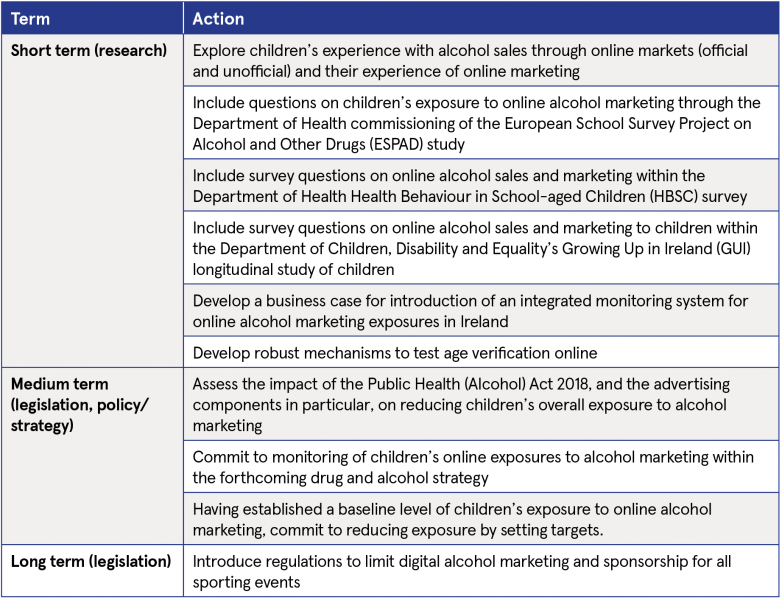
Specifically for alcohol marketing, the report outlines short, medium and long-term goals outlined in Table 1.
Conclusion
Overall, addressing children’s exposure to harmful digital marketing is identified as a significant public health and children’s rights issue requiring coordinated and sustained action.
Table 1: Options to reduce digital sales and marketing of alcohol to children in Ireland
O’Connor L, Reynolds CME and McAvoy H (2025) Digital marketing of health-harming products to children in Ireland – options for further protections. A report developed by the Institute of Public Health for the Online Health Taskforce. Institute of Public Health. Available from: https://www.drugsandalcohol.ie/44764/
A Substance use and dependence > Substance related societal (social) problems / harms
B Substances > Alcohol
MP-MR Policy, planning, economics, work and social services > Marketing and public relations (advertising)
N Communication, information and education > Digital technology
T Demographic characteristics > Child / children
T Demographic characteristics > Adolescent / youth (teenager / young person)
VA Geographic area > Europe > Ireland
Repository Staff Only: item control page