
Dillon, Lucy (2026) Registered tobacco and vaping lobbying activity in Ireland. Drugnet Ireland, Issue 95, July 2026, pp. 9-12.
| Preview | Title | Contact |
|---|---|---|
|
PDF (Drugnet Ireland 95)
3MB |
Lobbying can be an important element of democratic governance but in the case of tobacco control or other substances harmful to health, it can undermine public health interests. A new paper published in the journal Tobacco Control explores the extent, nature and targets of registered lobbying activities related to smoking and vaping in Ireland from 2016 to 2024.1
Context
Preventing the harms caused by tobacco use is complicated by its link with commercial interests. Hanrahan and Kavanagh, the authors of the paper, argue that ‘the commercial determinants of health, defined as the conditions, actions and omissions by commercial actors that affect health, are exemplified by the tobacco industry, which employs sophisticated strategies to shape policy, undermine regulation and delay or dilute effective tobacco control measures.’ (p. 1).1 In recognition of the efforts of the tobacco industry to influence public health policy, the World Health Organization (WHO) introduced Article 5.3 of the Framework Convention on Tobacco Control (FCTC) which requires countries to protect tobacco control-related public health policies from industry interference. Ireland is a signatory of the FCTC, but there are gaps in its implementation.
Data source and research aim
Under the Regulation of Lobbying Act 2015, Ireland established a publicly available online Lobbying Register to improve standards in public life. It provides information on the communications from lobbyists to designated public officials (DPOs). Hanrahan and Kavanagh describe the Register as ‘regarded as comprehensive and robust’ (p. 2).1 They use data from this register to describe the landscape of lobbying on both tobacco and e-cigarette policy between 2016 and 2024, by identifying the lobbyists and exploring when, how and for what policy aims the lobbying happened.
Methods
Two forms of analysis were carried out on 511 entries that were found to be relevant to the research question and have substantive information.
First, entries were analysed using thematic analysis which was carried out on three fields for each lobbying entry in order to identify recurring themes: specific details (a free text description of lobbying activities); relevant subject matter (one of: ‘legislation’, ‘matters involving public funds’ or ‘public policy or programme’); and, intended results (a free text description of purpose of lobbying activities). Some submissions had more than one lobbying purpose.
Second, quantitative analysis was carried out to describe the frequency and distribution of registered lobbying activities by reporting period, year, and lobbying group. Given the structure of the Register, the unit of study was a submission by a lobby group rather than the number of communications within a submission. Therefore, a single submission could include one email or 10. They were required to report the types of interactions (e.g. meetings, written communications) not the number.
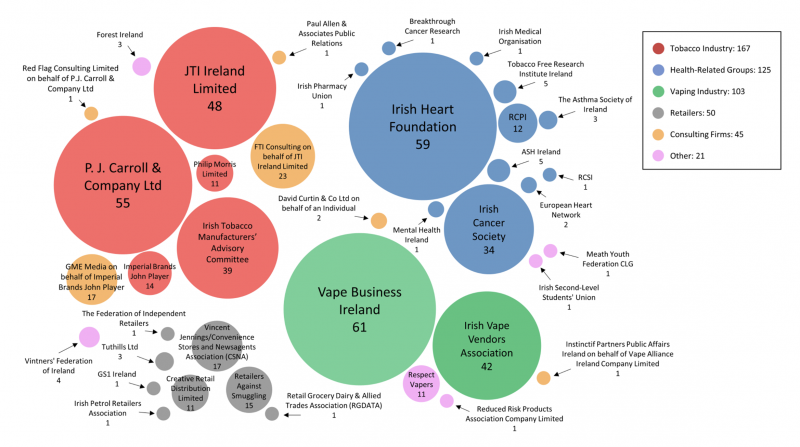
Figure 1: Number of lobbying submissions per lobbying group and entity. ASH, Action on Smoking and Health; CLG, Company Limited By Guarantee; JTI, Japan Tobacco International; RCPI, Royal College of Physicians Ireland; RCSI, Royal College of Surgeons in Ireland (p. 3)1
Findings
The findings of the paper are structured around five questions:
Who is lobbying?
- Thirty-nine lobbying entities were found to be active in the tobacco and vaping policy field between 2016 and 2024 (see Figure 1).
- While Vape Business Ireland was the most active, when submissions made by Japan Tobacco International (JTI) Ireland and a consulting firm that lobbied on its behalf (FTI Consulting) are combined, JTI Ireland was the most active.
- Health-related groups had 2.9 times fewer entries when compared with the commercial groups combined (tobacco and vaping industry, consulting firms and retailers) – 125 versus 365, respectively.
When did lobbying take place?
Between 2016 and 2024 there was a relatively constant flow of smoking and vaping-related lobbying in Ireland (except for some reduction in 2020, which is attributed to the COVID-19 pandemic).
How was lobbying conducted?
Given the structure of the Register, submissions could include more than one form of communication: 89% of submissions included some form of written communication (email or letter), 24% at least one in-person meeting, and 22% a phone call or virtual meeting. Other forms of communication were holding events (4%), social media interaction (1%), informal communication (2%), and unknown (1%).
What were they lobbying for?
Hanrahan and Kavanagh’s analysis identified six themes in the data on which groups were lobbying.
- Taxation and excise duty: 14.1% of submissions related to taxation and excise duty. Tobacco companies lobbied against increases, while health-related groups lobbied in favour of them.
- Illicit tobacco trade: 13.6% of submissions had the illicit tobacco trade as a theme. For example, the tobacco industry highlighted the associated economic costs, while health-related groups focused on the WHO FCTC protocols to eliminate such trade.
- Vaping regulations and policies: The Public Health (Tobacco Products and Nicotine Inhaling Products) Act 2023 was mentioned in 11.5% of submissions. The vaping industry and related groups advocated for e-cigarettes to be considered a harm-reduction/smoking cessation tool. While they also argued for strict enforcement of age restrictions, they lobbied against bans on flavours. Health-related groups lobbied for age-related restrictions and bans on flavours, and certain packaging and marketing that may be attractive to children and young people.
- Raising the legal age of sale of tobacco (‘Tobacco 21’): The Public Health (Tobacco) Amendment Act 2024 arose in submissions later in the study period. A total of 6.6% of all submissions referred to it. There was relatively little opposition to the proposed measure.
- Smoking cessation programmes: 3.7% of lobbying submissions included this theme and only health-related groups lobbied on it.
- Outdoor smoking bans: Only 1.4% of submissions dealt with this theme, which looked at the expansion of the smoking ban to outdoor areas by health-led groups. There was one submission from the hospitality industry which queried its practical implementation.
Who were lobbying groups targeting?
A total of 481 individual DPOs were named 2,932 times across the submissions analysed. Seventy-two per cent of submissions targeted three or fewer DPOs. Seventy-two per cent targeted members of Dáil Éireann, 18% targeted members of the Seanad, 4% targeted city/county councils, 3% targeted members of the European Parliament, and 2% targeted other public servants (with a non-political role). The Minister of Health was listed in 20% of submissions (51% from commercial actors), and the Minister of Finance was listed in 11% (68% from commercial actors).
Discussion
Hanrahan and Kavanagh argue that ‘this study shows that efforts to subvert tobacco-related and vaping-related policy-making are pervasive and persistent, including meetings with DPOs, especially where engagement is led through strategic consulting companies. The voice of health-related groups remains strong, although relatively crowded out in registered lobbying activity by commercial interests.’ (p. 6).1 A number of recommendations emerge from their discussion of the findings, which include:
- The presence of former DPOs as lobbyists for the vaping industry and retailers raised concerns. Hanrahan and Kavanagh suggest a ‘cooling off’ period for DPOs to ensure that potential conflicts of interest can be addressed.
- The broader strategic framework included in FCTC Article 5.3 should be implemented to support good governance.
- DPOs should be provided with training to build resilience against tobacco and vaping industry interference in policy-making. This should include guidance on Article 5.3 adherence.
- The use of ‘front groups’ needs to be monitored; for example, groups such as Vape Business Ireland and Respect Vapers which have links to the tobacco industry.
- The Lobbying Register could be improved. For example, this could be done by providing more transparency on which DPOs attend meetings with lobbyists; require more detail about meetings such as meeting agendas, items discussed and any commitments made; and to mandate validation of the register by public officials.
In conclusion, they argue that Irish policy-makers need to renew their tobacco endgame commitment.
1 Hanrahan M and Kavanagh P (2026) Registered tobacco and vaping lobbying activity in Ireland, 2016-2024: the case for strengthening implementation of the Framework Convention of Tobacco Control Article 5.3 to clear the path for tobacco endgame. Tob. Control, https://doi.org/10.1136/tc-2025-059758. Available from: https://www.drugsandalcohol.ie/45367/
B Substances > Tobacco (cigarette smoking) > Nicotine product (e-cigarette / vaping / heated)
MP-MR Policy, planning, economics, work and social services > Political activity > Lobbying
MP-MR Policy, planning, economics, work and social services > Substance industry, trade or business
VA Geographic area > Europe > Ireland
Repository Staff Only: item control page