
Dillon, Lucy (2026) Women and Ireland’s alcohol and drug strategies, 1996-2025. Drugnet Ireland, Issue 95, July 2026, pp. 5-8.
| Preview | Title | Contact |
|---|---|---|
|
PDF (Drugnet Ireland 95)
3MB |
Introduction
Drug policy, practice and resource allocation have been driven largely by Ireland’s national drug strategies since 1996. The Drugs: Education, Prevention and Policy journal has published a paper that examines how the needs of Irish women who use alcohol and other drugs have been addressed in these strategies and a selection of other key policy documents since 1996.1,2,3,4,5,6,7 From denial to pregnancy and motherhood to ‘gender informed’? Women and Ireland’s alcohol and drug strategies, 1996-2025 was published prior to the release of Ireland’s draft National Drugs Strategy (2026–2029).8 The paper’s authors, Windle and Cronin, found that Irish alcohol and drug policy did not initially recognise women’s drug use. When it was recognised, it focused almost exclusively on pregnancy and motherhood. Only since 2017 has it promoted gender-informed approaches.
Context
Women who use alcohol and drugs problematically in Ireland account for:
- 27% of people who entered treatment in 2022 for illicit drug use
- Close to 40% of those who entered treatment and reported alcohol as their ‘main problem drug’ in 2023
- 34% of Ireland’s drug-induced deaths in 2020
- 27.3% of alcohol-related deaths in 2022 (p.2)8
The paper is grounded in an understanding that women’s experiences of substance use and associated services are different to those of men. Therefore, services and the strategies and policies that guide them need to be gender sensitive. Windle and Cronin sought to critically assess how ‘three decades of Irish alcohol and drug policy has framed the needs of women who use illicit drugs and/or alcohol’ (p. 2).8
Methodology
Four national alcohol and drug strategies and three other key documents were analysed for this research (see Figure 2).1,2,3,4,5,6,7 Two forms of analysis were carried out:
Content analysis: Windle and Cronin looked at the frequency counts for a range of words to describe men and women in each of the four strategies.
Critical policy analysis: Windle and Cronin’s approach is based on Bacchi’s work on problematisation that has its foundation in feminist policy analysis.9 Bacchi identifies six questions that guide an analysis approach of how governments respond to problems and are active in the creation (or production) of policy problems (p 3).8 The six questions are:
- What is the problem represented to be in a specific policy or policies?
- What deep-seated presuppositions or assumptions (conceptual logics) underlie this representation of the ‘problem’?
- How has this representation of the ‘problem’ come about?
- What is left unproblematic in this problem representation? Where are the silences? Can the ‘problem’ be conceptualised differently?
- What effects (discursive, subjectification, lived) are produced by this representation of the ‘problem’?
- How and where has this representation of the ‘problem’ been produced, disseminated and defended? How has it been and/or how can it be disrupted and replaced?
Windle and Cronin focused on analysing the documents to answer questions 1–4. In doing so, they were interested in exploring both what is included in the documents and what is not, the ‘policy silences’ (p. 4).
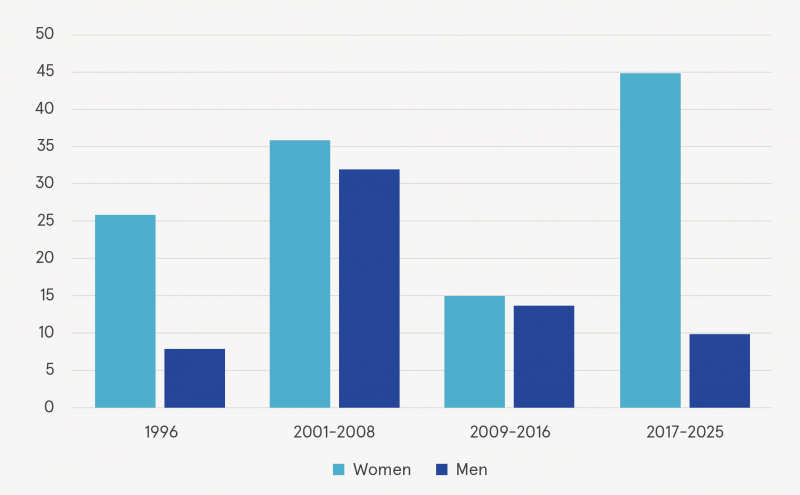
Figure 1: Content analysis. Overall counts of mentions of men and women in national drug strategies. (p. 3)8
Findings
The content analysis was described as ‘useful but limited’ (p. 2).8 It found that words used to describe women were more commonly found in the documents than words to describe men (see Figure 1). It is argued that women are mentioned explicitly because they are seen as a special population. In contrast, men are considered by policy-makers to be the norm within the population of people who use drugs – ‘if men are the norm, they do not need to be specifically mentioned’ (p. 3).8
Figure 2 summarises the findings of the analysis and how the needs of women who use drugs and alcohol are addressed in the chosen documents. The first cohort of ‘strategies’ (First Report of the Ministerial Task Force on Measures to Reduce the Demand for Drugs (the Rabbitte report), the National alcohol policy, and Building on Experience: National Drugs Strategy 2001–2008)1,2,4 focused on problematic drug use as affecting young, working class, men. Where women were mentioned, it was in the context of pregnancy, sex work (to a lesser extent), and implicitly when discussing the childcare needs of parents who use drugs.
Progress appeared to be made with the publication of the Report of the Working Group on Drugs Rehabilitation in 2007.5 For the first time, the differences between men and women’s drug use were identified, and it illustrated an understanding of the need for gender-specific services. However, this progress was short-lived and the report’s findings were not included in the subsequent national drugs strategy (2009-2016).6 According to Windle and Cronin, ‘the 2009-2016 strategy’s denial of gendered drug use represents a regression from a very low baseline’ (p. 5).8
In 2017, Reducing Harm, Supporting Recovery represented a significant change in Irish policy for how the needs of women who use alcohol and other drugs were addressed.7 For example, the strategy identifies the need to address gender-specific risk factors and services. It was ‘the first time that any Irish strategy identified the needs of women who were not pregnant, parents or sex workers.’ (p. 5).8
A key finding of the analysis is that pregnancy has been the core women-specific theme across all alcohol and drug strategies since 1996. While Windle and Cronin recognise the importance of supporting this cohort of women given the risks to their health and well-being and that of their child, they are critical that the strategies are ‘largely silent on women who are not pregnant, mothers, or sex workers’ (p. 6).8
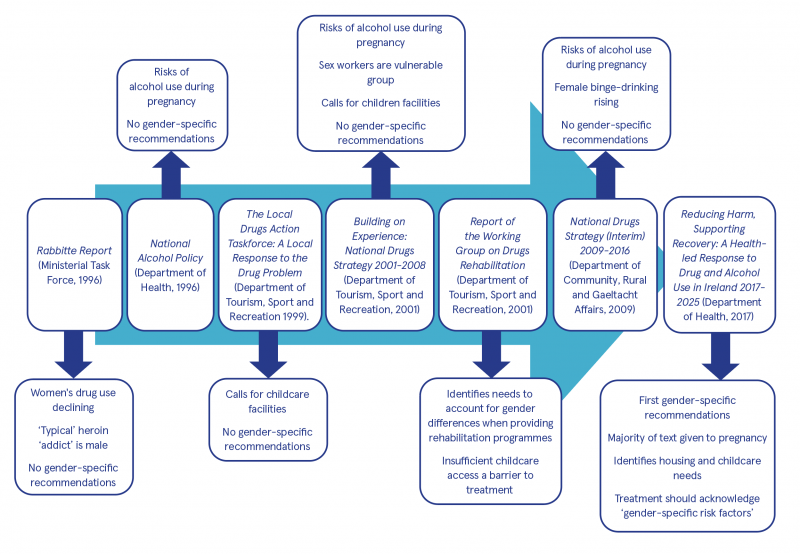
Figure 2: The development of Irish drug policy. (p. 6)8
Discussion
In their discussion, Windle and Cronin place their findings within Ireland’s wider social context. They discuss the traditionally patriarchal culture of Irish society and how this has impacted on policy and practice for women and their health more broadly. The paper concludes that progress over the past decade in relation to women’s (reproductive) healthcare, an increased understanding of health inequalities, and signs from policy-makers that a more gendered perspective is required for the next national drugs strategy, make it more likely that the needs of women who use drugs may be better met by Irish policy-makers. This article was published prior to the draft of the new national drugs strategy in February 2026. The draft strategy’s content suggests that the needs of women who use drugs will be a focus of the new strategy.
1 Ministerial Task Force (1996) First Report of the Ministerial Task Force on Measures to Reduce the Demand for Drugs. Dublin: The Stationery Office. Available from: https://www.drugsandalcohol.ie/5058/
2 Department of Health (1996) National alcohol policy. Dublin: The Stationery Office. Available from: https://www.drugsandalcohol.ie/5263/
3 Department of Tourism, Sport and Recreation (1999) The local drugs action taskforce: A local response to the drug problem. Dublin: The Stationery Office. Available from: https://www.drugsandalcohol.ie/3477/
4 Department of Tourism, Sport and Recreation (2001) Building on Experience: National Drugs Strategy 2001–2008. Dublin: The Stationery Office. Available from: https://www.drugsandalcohol.ie/5187/
5 Department of Community, Rural and Gaeltacht Affairs (2007) National Drugs Strategy 2001-2008: Rehabilitation. Report of the Working Group on Drugs Rehabilitation. Dublin: The Stationery Office. Available from:
https://www.drugsandalcohol.ie/6267/
6 Department of Community, Rural and Gaeltacht Affairs (2009) National Drugs Strategy (interim) 2009-2016. Dublin: The Stationery Office. Available from: https://www.drugsandalcohol.ie/12388/
7 Department of Health (2017) Reducing harm, supporting recovery: A health-led response to drug and alcohol use in Ireland 2017-2025. Dublin: The Stationery Office. Available from: https://www.drugsandalcohol.ie/27603/
8 Windle J and Cronin J (2025) From denial to pregnancy and motherhood to ‘gender informed’? Women and Ireland’s alcohol and drug strategies, 1996-2025. Drugs Educ. Prev. Policy, Early online, https://doi.org/10.1080/09687637.2025.2566004. Available from: https://www.drugsandalcohol.ie/44351/
9 Bacchi C (2009) Analysing policy: What’s the problem represented to be? French’s Forest, NSW: Pearson.
MP-MR Policy, planning, economics, work and social services > Policy > Policy on substance use
MP-MR Policy, planning, economics, work and social services > Programme planning, implementation, and evaluation > Programme planning (strategy)
T Demographic characteristics > Woman (women / female)
T Demographic characteristics > Gender / sex differences
VA Geographic area > Europe > Ireland
Repository Staff Only: item control page