
Millar, Seán R  ORCID: https://orcid.org/0000-0003-4453-8446
(2026)
National Self-Harm Registry Ireland annual report, 2024.
Drugnet Ireland,
Issue 94, April 2026,
pp. 18-20.
ORCID: https://orcid.org/0000-0003-4453-8446
(2026)
National Self-Harm Registry Ireland annual report, 2024.
Drugnet Ireland,
Issue 94, April 2026,
pp. 18-20.
| Preview | Title | Contact |
|---|---|---|
|
PDF (Drugnet Ireland 94)
1MB |
In December 2025, the National Suicide Research Foundation published the 2024 National Self-Harm Registry Ireland annual report.1 The report contains information relating to every recorded presentation of deliberate self-harm to acute hospital emergency departments in Ireland in 2024, as well as details of complete national coverage of cases treated. All individuals who were alive on admission to hospital following deliberate self-harm were included, along with the methods of deliberate self-harm that were used. Accidental overdoses of medication, street drugs, or alcohol were not included.
Rates of self-harm
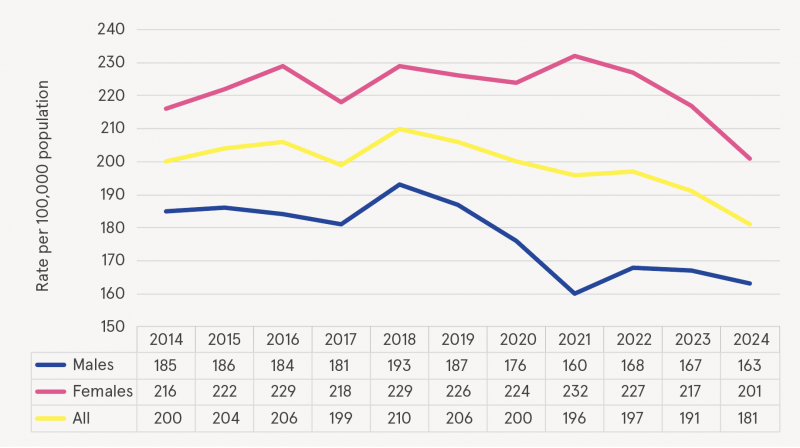
In 2024, the National Self-Harm Registry Ireland estimated that there were a total of 12,621 self-harm presentations made by 9,436 individuals. The age-standardised rate of individuals presenting to hospital in the Republic of Ireland following self-harm in 2024 was 181 per 100,000 population (Figure 1). This is 5% lower than the rate in 2023, and 19% lower than the peak rate recorded by the Registry in 2010 (223 per 100,000).
In 2024, the national male rate of self-harm was 163 per 100,000 population, which was 2% lower than the rate in 2023. The female rate was 201 per 100,000 population in 2024, 7% lower than in 2023. The female rate in 2024 is the lowest rate recorded by the Registry for women, and marks a continuation of the decrease observed for women since 2021.
Source: National Suicide Research Foundation (2025)
‘All’ in the legend refers to the rate for both men and women per 100,000 population.
Figure 1: Person-based rate of deliberate self-harm from 2014 to 2024, by sex
Self-harm and drug use
Intentional drug overdose (IDO) was the most common form of deliberate self-harm reported in 2024, occurring in 61% of episodes. As observed in 2024, overdose rates were higher among women (63%) than among men (59%). Minor tranquillisers and major tranquillisers were involved in 28% and 11% of drug overdose acts, respectively. In total, 32% of male overdose cases and 47% of female overdose cases involved analgesic drugs, most commonly paracetamol, which was involved in 30% of all drug overdose acts. In 69% of cases, the total number of tablets taken was known, with an average of 29 tablets taken in episodes of self-harm that involved a drug overdose.
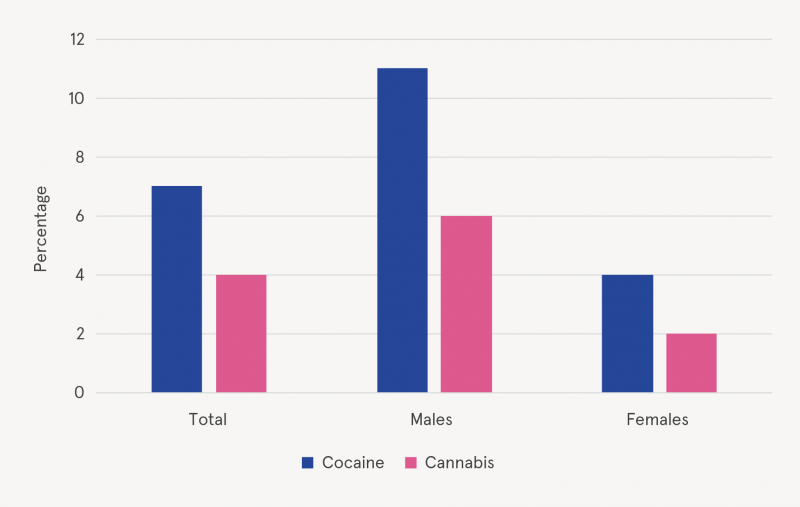
Since 2022, information has been recorded by the Registry about whether cocaine or cannabis was involved in self-harm presentations. Figure 2 presents information on cocaine and cannabis involvement in self-harm presentations in 2024. Of all presentations in 2024, cocaine was involved in 7% of presentations, while cannabis was involved in 4%. A greater proportion of men used cocaine and cannabis in comparison to women (11% versus 4% for cocaine and 6% versus 2% for cannabis). For both drugs, the majority (57–63%) of presentations by men and women were among those aged 20–34 years.
Source: National Suicide Research Foundation (2025)
Figure 2: Cannabis and cocaine involvement in self-harm presentations, 2024
1 Joyce M, Chakraborty S, McGuiggan JC, et al. (2025). National Self-Harm Registry Ireland annual report 2024. Cork: National Suicide Research Foundation. Available from: https://www.drugsandalcohol.ie/44719/
B Substances > Substances in general
B Substances > Cocaine
E Concepts in biomedical areas > Medical substance > Over the counter drug (medicine / medication)
F Concepts in psychology > Behaviour > Self-destructive behaviour / self-harm
G Health and disease > State of health > Mental health
G Health and disease > Substance use disorder (addiction) > Drug use disorder > Drug intoxication > Poisoning (overdose)
T Demographic characteristics > Gender / sex differences
VA Geographic area > Europe > Ireland
Repository Staff Only: item control page