
Dillon, Lucy (2026) EU drugs strategy. Drugnet Ireland, Issue 94, April 2026, pp. 8-11.
| Preview | Title | Contact |
|---|---|---|
|
PDF (Drugnet Ireland 94)
1MB |
In early December 2025, the European Commission published the new EU Drugs Strategy.1 The strategy is structured around five pillars (see Figure 1,) each of which is made up of a set of strategic priorities. It summarises the key priorities and how they relate to delivery at the levels of the European Commission, the European Drugs Agency (EUDA) (and other relevant EU agencies), and Member States. The pillars and key priorities, as presented in the strategy document, are outlined below.
Pillar 1: To enhance EU and national preparedness to anticipate and respond to drug-related health and security threats
Key priorities
The European Commission and Member States, with the support of relevant EU agencies, should:
- facilitate knowledge sharing and the identification of research priorities via research dialogues
- coordinate operational support and dissemination of innovative practices and solutions to relevant actors in the drug sector.
In line with its extended mandate, the EUDA will:
- upgrade the EU early warning system to identify swiftly and systematically new psychoactive substances and disseminate this information to the Member States
- implement a European drug alert system to issue targeted rapid health and security alerts on serious drug-related risks
- develop threat assessments on new drug-related health and security threats and carry out a specific threat assessment on highly potent synthetic opioids in Europe
- improve the timely monitoring of the drug situation by scaling up EU-wide data collection, notably building on rapid reporting from the Reitox National Focal Points.
Member States are encouraged to:
- develop national preparedness and response measures with actions to anticipate and mitigate new and emerging drug-related threats.
Pillar 2: To protect public health via evidence-based preventive approaches and treatment
Key priorities
The European Commission will:
- step up efforts on preventive health, rolling out the Healthier Together – EU non-communicable diseases initiative
- take forward its flagship projects under the communication on a comprehensive approach to mental health.
The EUDA will:
- support Member States in designing effective awareness-raising activities on the impact of drug use and drug trafficking
- develop and promote EU-wide comprehensive guidance on minimum quality standards and advise Member States on implementing effective prevention and treatment.
Member States are encouraged to:
- step up universal and environmental health prevention and develop and implement evidence-based prevention activities specifically designed for groups in vulnerable situations and young people
- strengthen the availability of evidence-based treatment options integrated in a continuum of care and addressing increased stimulant use
- promote the integration of people using drugs, via social support measures, as well as strengthen and expand the availability of alternatives to pre-trial detention and coercive sanctions for drug-related offences.
Pillar 3: To improve security and protect society by addressing drug production and trafficking and combatting criminal infiltration
Key priorities
The European Commission will:
implement, in close collaboration with Member States and relevant EU agencies, the dedicated EU action plan against drug trafficking
- evaluate the existing Framework Decision on drug trafficking in 2026
- deliver an EU Ports Strategy with a strong focus on port security
- work with the co-legislators to advance the swift adoption of the new rules on precursors
- assess the feasibility of establishing a new EU-wide system to track financing related to both organised crime and terrorism.
The EUDA, with the support of the European Multidisciplinary Platform Against Criminal Threats (EMPACT), will:
- develop a European database on drug production incidents.
- Member States are encouraged to:
- reinforce national authorities’ capacities to detect, investigate and prosecute drug trafficking
- incorporate into national law and implement the strengthened rules on asset recovery and confiscation
- detect and prevent criminal infiltration into legal businesses through the administrative approach.
Pillar 4: To address drug-related harm to protect individuals and society with measures that address individual health as well as social and environmental damages
Key priorities
The European Commission will:
- develop and disseminate, through the EU Crime Prevention Network, a dedicated EU toolbox to address the recruitment of minors by criminal networks
- leverage the strengthened EMPACT framework for operational law enforcement cooperation to tackle illicit drug production facilities as part of the implementation of the action plan against drug trafficking.
The EUDA will:
- develop the European Harm Reduction Curriculum to support capacity-building on harm reduction interventions across the EU
- work closely with Member States to develop and implement their crime prevention measures in support of local communities and young people.
Member States are encouraged to:
- increase the availability of harm and risk reduction interventions and coverage to reduce drug overdoses, deaths, and blood-borne infections across the EU
- adopt zero-tolerance policies for driving under the influence of drugs, in line with the Driving Licence Directive, and make full use of available cross-border tools to enforce these rules
- make full use of the new Environmental Crime Directive to respond to the environmental challenges arising from drug production and trafficking.
Pillar 5: To build strong partnerships to address the drug situation, in particular with third countries and regions
Key priorities
The European Commission, in cooperation with the Council of the EU and Member States, will:
- strengthen international dialogues on drugs with third countries and regions, including efforts to reinforce and expand international alliances against synthetic drugs
- continue to lead EU participation in UN drug policy processes and promote a human rights and balanced approach to drug policy.
The European Commission, with the support of EU agencies, will:
- strengthen operational cooperation to address drug trafficking with candidate countries and key third countries and regions
- join efforts with Member States to drive forward the European Coalition against Drugs.
The European Commission and Member States should:
- step up engagement with the Civil Society Forum on Drugs
- promote public-private partnerships on drug policy.
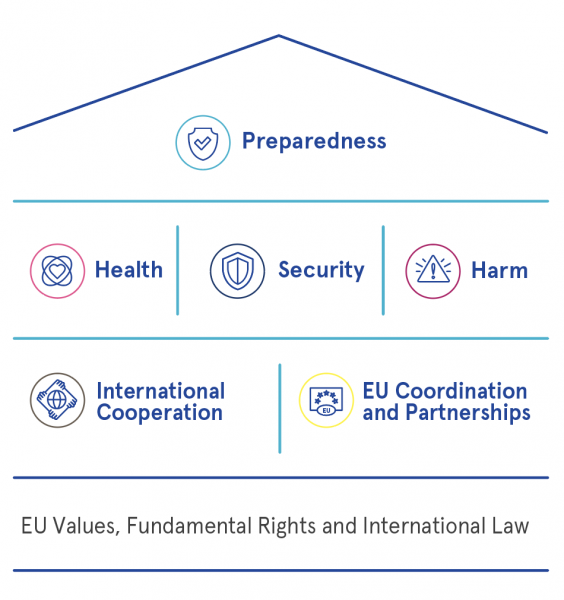
Figure 1: EU Drugs Strategy framework of strategic pillars (p. 2)1
Concluding comment
The new EU Drugs Strategy reflects the complexity of the issues facing the EU, its agencies and Member States in relation to drugs and the harms they can cause. It highlights the need for a coordinated policy response across Member States that supports effective health, social and security measures to meet current challenges and to be prepared for those in the future. By identifying priorities at the Member State level, the strategy allows for national drugs strategies to take account of these. Ireland’s draft national drugs strategy for Ireland has sought to align itself with its European counterpart.
1 European Commission (2025) Communication from the European Commission to the European Parliament and the Council on the EU Drugs Strategy. Brussels: European Commission. COM(2025) 743 final. Available from: https://www.drugsandalcohol.ie/44723/
MP-MR Policy, planning, economics, work and social services > Policy > Policy on substance use
MP-MR Policy, planning, economics, work and social services > Programme planning, implementation, and evaluation > Programme planning (strategy)
VA Geographic area > Europe
VA Geographic area > Europe > Ireland
VA Geographic area > Europe > European Union
Repository Staff Only: item control page