
HRB National Drugs Library
Key Irish data > Deaths data
The National Drug-Related Deaths Index (NDRDI) provides information about the number of deaths by drug and alcohol poisoning; and deaths among drug users and people who are alcohol dependent in Ireland. The most recent bulletin (with 2022 data) was published in December 2025.
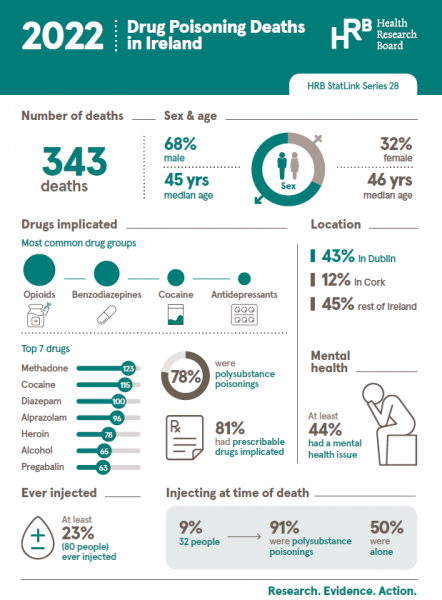
- There were 343 drug poisoning deaths were recorded in Ireland in 2022. This represents an 8% decrease on 2021 (373 deaths). It is the second consecutive year that these deaths have fallen.
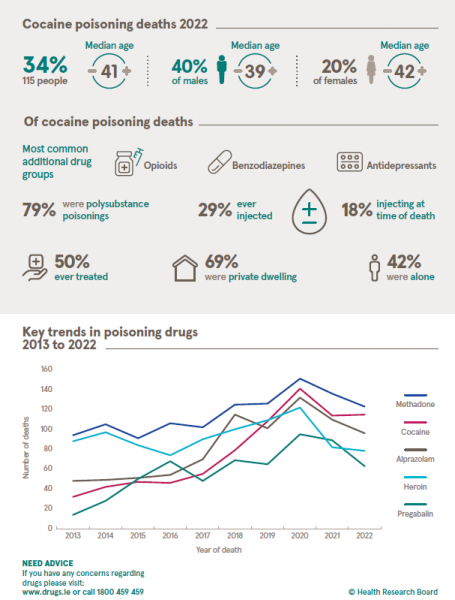
- Rise in cocaine - Cocaine was the second most common drug overall in 2022. It was involved in one in three drug poisoning deaths that year. In 2022, 8 in 10 deaths involving cocaine also involved other drugs, most commonly heroin, methadone and other prescription drugs. Between 2013-2022 cocaine poisoning deaths increased by 259%, the largest increase of any drug group*.
- The people behind the statistics - In 2022, the median age was 45 years for men, and 46 for women. Two in five people had a history of mental health issues. Almost one in two were alone when the poisoning occurred. Almost one in ten were injecting at the time of death. At least two in five were not in employment; most were living in stable accommodation; almost half lived in Dublin (city or county); and more than one in 10 were experiencing homelessness.
- Drug poisoning deaths in men versus women - Men account for the majority of drug poisoning deaths, similar to previous years. Cocaine was the top drug implicated and was involved in two in five of male deaths in 2022. Cocaine was followed by methadone, alprazolam and diazepam. For women, methadone was the top drug involved in poisoning deaths in 2022, when it was implicated in three in ten of these deaths. Methadone was followed by diazepam and pregabalin. Most heroin deaths (82%) were among men. Gabapentinoid/antiepileptic drugs, including pregabalin, were implicated in a greater proportion of deaths among women, as were antidepressants.
- Opioids and other drugs - While cocaine and heroin were the main illicit drugs implicated in drug poisoning deaths in 2022, the majority involved prescribable drugs. Almost 8 in 10 poisonings involved more than one drug. The most common drugs involved were methadone, diazepam, alprazolam, pregabalin, and Zopiclone. Opioids accounted for two in three deaths. Methadone was the most common opioid, and most deaths involving methadone were polysubstance poisonings. Methadone increased 31% between 2013 and 2022 but decreased 19% between 2020 and 2022. Heroin also decreased 11% over the period 2013 to 2022, with a notable decrease of 36% between 2020 and 2022.
- Alcohol-related deaths - In 2022, alcohol was implicated in one in five deaths, along with other drugs. Alcohol as part of polysubstance poisoning decreased 26% between 2020 and 2022.
Related NDRDI publication, published April 2026 - Deaths among people who were homeless at time of death in Ireland, 2022.
The information is used to develop health and social service responses aimed at reducing the number of deaths. The number of drug-related deaths and deaths among drug users is one of the European Union Drugs Agency key indicators to measure the consequences of drug use. The National Drug-Related Death Index Steering Committee provides advice to the researchers on the development of the data collection protocol, the methodology for interpreting inconclusive cases, and pathology and toxicology
Staff from the NDRDI collect data from Coroner Service files relating to all deaths among alcohol dependent person, all deaths where a history of drug use was recorded or where drug or alcohol misuse was implicated in the death. Data from the other agencies is collected in electronic format.
The data is collected from a number of sources, including:
- The Coroner Service;
- The General Mortality Register;
- The Central Treatment List;
- HIPE
- HSE PCRS
The information collected includes:
- Administrative details
- Demographic details
- Socio-economic information
- Problem drug use at the time of death
- Risk behaviours
- Drug treatment history
- Details about the death itself
- Medical diagnosis.
This information is used to define accurately the extent of the problem, to inform policy and to assess the effectiveness of responses aimed at preventing deaths from drug or alcohol misuse. The Health Research Board is the data controller with overall responsibility for the data.
For researchers, and all others requiring data, please complete the National Health Information Systems (NHIS) data request form and accept the terms and conditions for use of NDRDI data. The form is a PDF in editable format and when filled out can be returned to: ndrdi@hrb.ie.
This page was last updated in April 2026