
O'Sullivan, Michael (2026) Traveller substance use in Ireland: a national study. Drugnet Ireland, Issue 96, October 2026, pp. 26-28.
| Preview | Title | Contact |
|---|---|---|
|
PDF (Drugnet Ireland 96)
2MB |
A new national study on substance use among Travellers in Ireland provides comprehensive evidence on the burden of substance use experienced by the Traveller community and the structural factors that contribute to it.1
The study was commissioned by the Eastern Region Traveller Health Unit, Health Service Executive (HSE), and Pavee Point Traveller and Roma Centre. The research was conducted by Trinity College Dublin.
The report, which includes an overview of the existing policy context, also generated a number of recommendations to address substance use and its impacts in the community. It was formally launched in April at Pavee Point by the Minister of State for Public Health, Wellbeing and the National Drugs Strategy, Jennifer Murnane O’Connor.
Methodology
The mixed methods research included interviews and focus groups with Travellers who have lived/living experience of drug use, as well as Traveller community workers, key stakeholders, and service providers. The research also included an analysis of 17 years of national treatment data from the National Drug Treatment Reporting System (NDTRS).
Findings
Addiction treatment data
Travellers are overrepresented in addiction treatment, accounting for 2.5% of treatment episodes despite representing less than 1% of the total population in Ireland. Treatment completion is less common for Travellers than for the wider population (35% versus 47% completion). Higher rates of polydrug use among those treated were reported, and among the Traveller community more than one-half of those entering treatment were parents.
Since 2008, alcohol and opioids have been consistently reported as the main problem drugs for Traveller men and women, while opioids were more commonly reported as the main problem drug among Traveller women. Despite this, there has been a significant rise in the number of Traveller men and women accessing treatment for cocaine since 2008.
Qualitative reports
Participants acknowledged that early exposure to racism and discrimination shaped how they experienced wider society, including education and health services. Indicators of societal disadvantage – including unemployment, overcrowding, and poor living conditions – were mentioned as factors contributing to drug use. At the personal and social level, poor mental health and high suicide rates, the breakdown of relationships and support networks, together with violence and drug debts, were cited as risk factors for drug use, and also cited as impacts and outcomes of drug use.
Barriers for Travellers seeking support were highlighted; these included the availability of services and a mistrust and lack of confidence in services to fully understand Traveller needs. Traveller women highlighted specific barriers that they have experienced when accessing health services, including failures to have their health concerns addressed fully, and the lack of accessible and appropriate childcare support.
Conclusions
While treatment data from the NDTRS indicate that Travellers are more likely to seek support for addiction, the qualitative insights echo that tackling substance use requires more than the expansion of addiction services. Such findings reinforce the importance of a holistic approach, addressing social determinants of health, including poverty, discrimination, housing conditions, and educational disadvantage, in order to support more positive outcomes in engagement and treatment. These interrelated deprivations mean that a coordinated response across Government Departments and agencies will be needed to address the structural factors that contribute to substance-related harm.
A clear argument is made that a stronger focus on culturally appropriate and accessible care that can build trust with Traveller communities is needed; this would include Traveller-led and community-based responses and further supports to build the capacity of Traveller organisations. The findings underline the importance of investing in prevention and early intervention initiatives, particularly for younger Travellers, to reduce the long-term personal, family, and community impacts associated with substance use. In addition, the report highlights a clear need to address gender-based differences in treatment and support needs.
The study provides an important evidence base for policy-makers and service providers and is a timely call for action as the final stages of agreeing the new national drugs strategy approach.
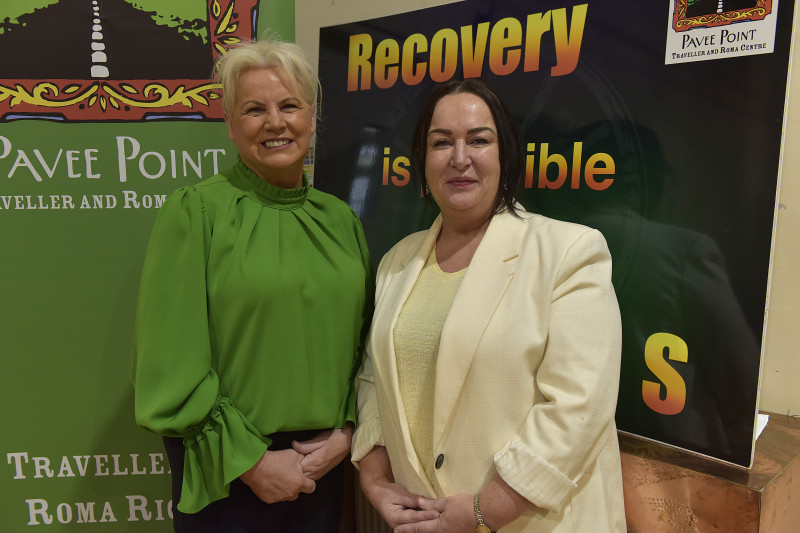
From L-R: Jennifer Murnane O'Connor, Minister of State at the Department of Health with special responsibility for Public Health, Wellbeing and the National Drugs Strategy; Anne Marie Sweeney, Peer Outreach Project Worker for the Traveller Community with Coolmine Therapeutic Community in North Dublin.
Recommendations
The report calls for a strengthened, coordinated response to Traveller substance use, with a number of overarching recommendations including:
- targeted national policy and research responses
- specific measures to improve access, participation, and outcomes in addiction services
- increased investment in Traveller-specific services and supports
- expansion of culturally appropriate and community-based interventions
- enhanced partnership working with Traveller organisations
- broader actions to address social determinants of health and discrimination.
The study suggests that Traveller substance use should be viewed as both a public health issue and a social justice issue. The report highlights the need for broader actions to address inequalities, discrimination, housing conditions, and access to health services. At the same time, a culturally appropriate approach to addiction treatment is required. Such an approach would see greater partnerships with Traveller organisations, with the overall aim of improving access to support and treatment outcomes. The study and recommendations have broad implications not only for addiction policy but also for Traveller health, equality, and social inclusion policy.
1 Comiskey C and O’Neill D (2026) Traveller Substance Use in Ireland: A National Study. Dublin: Eastern Region Traveller Health Unit, Health Service Executive, and Pavee Point Traveller and Roma Centre. https://www.drugsandalcohol.ie/45504/
Repository Staff Only: item control page