
Tierney, Paula  ORCID: https://orcid.org/0000-0003-0428-9457
(2026)
2025 drug treatment demand.
Drugnet Ireland,
Issue 95, July 2026,
pp. 42-47.
ORCID: https://orcid.org/0000-0003-0428-9457
(2026)
2025 drug treatment demand.
Drugnet Ireland,
Issue 95, July 2026,
pp. 42-47.
| Preview | Title | Contact |
|---|---|---|
|
PDF (Drugnet Ireland 95)
3MB |
The latest report from the National Drug Treatment Reporting System (NDTRS) on drug treatment demand in Ireland was published in May, providing statistics and trends on drug treatment cases, excluding alcohol.1 The publication includes data for the years 2017–2025.
The report outlines key findings on main problem drugs, sociodemographic characteristics, and health region of residence. It also focuses on three main themes: polydrug use, risk factors, and cocaine use.
The full report, along with accompanying data tables, are available to download from the HRB website.1
Key findings
In 2025, 15,422 cases were treated for problem drug use (excluding alcohol), the highest annual total recorded by the NDTRS. This reflects an increase in treated cases alongside improved data reporting from prison-based treatment services during 2025.
One in three cases (33.3%) were never treated before. The majority of cases were treated in outpatient facilities (65.8%).
Main problem drugs generating treatment demand
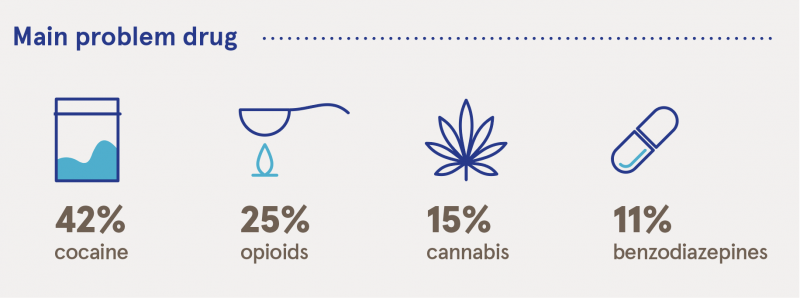
Cocaine was the most common main problem drug reported in 2025, accounting for four in ten (42.4%) cases entering treatment for problem cocaine use in that year. This represents a 335.7% increase from 2017.
Opioids, mainly heroin, were the second most common main problem drug reported in 2025, accounting for one in four cases (25.3%). Treatment demand for opioids has decreased since 2017, when opioids as a main problem drug accounted for 45.0% of cases.
Cannabis and benzodiazepines were the third and fourth, respectively, most common main problem drugs reported in 2025, similar to previous years. The number and proportion of cannabis-related treatment cases have declined since 2019.
The 2025 report also highlights some new trends in drug treatment demand:
- Cases where new psychoactive substances (NPS) were the main problem drug increased more than 400% between 2017 and 2025.
- The total number of cases recording ketamine as a problem drug (as a main problem or secondary problem) in 2025 was more than 12 times the number recorded in 2017.
- Vaping as a route of administration increased from 100 cases in 2024 to 249 cases in 2025.
Age groups
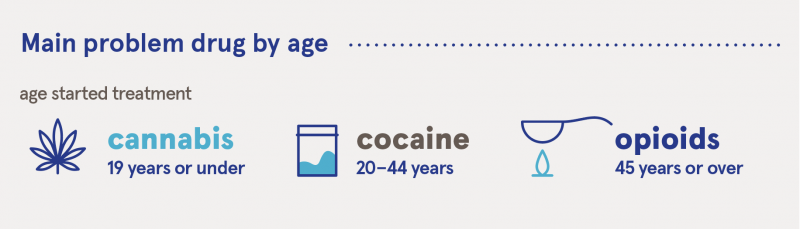
The most common problem drug varied by age group and this has changed over time:
- Cannabis was the most common problem drug among younger people, notably among cases aged under 19 years
- Cocaine was the most common problem drug among those aged 20–44 years
- Opioids were the most common problem drug among the older age groups of 45 years or over.
Sociodemographic characteristics
- Males comprised 69.4% of cases
- Irish Travellers comprised 2.9% of cases
- Almost two-thirds (59.2%) of cases were unemployed
- 11.6% of cases were experiencing homelessness at the time of starting treatment
The age profile of cases entering drug treatment continued to shift in 2025, indicating an increasingly ageing treatment population:
- The median age of cases increased from 30 years in 2017 to 35 years in 2025
- The proportion of younger service users has declined over the 9-year period
- The proportion of those aged 50 years or over has more than doubled since 2017
HSE health regions
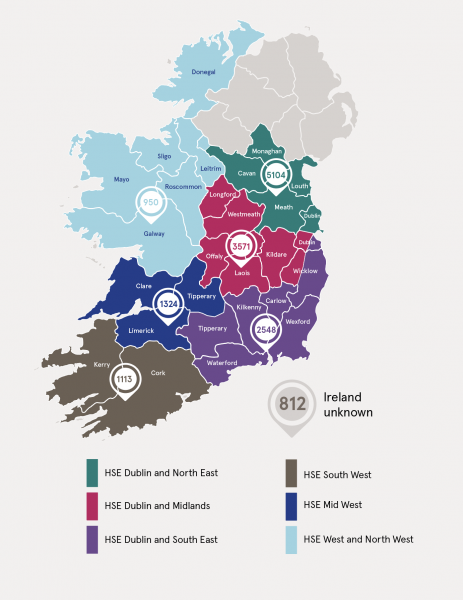
The number of recorded treatment cases increased between 2024 and 2025 across all six HSE health regions. HSE Dublin and North East Health Region had the highest number of cases in 2025.
Cocaine treatment demand
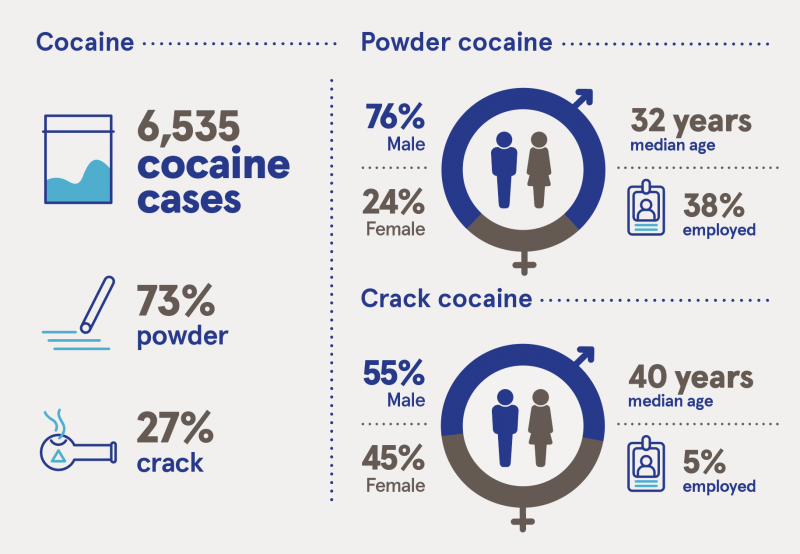
A total of 6,535 cases reported cocaine as a main problem drug in 2025, an increase of 23.6% since 2024 and an increase of 335.7% since 2017. Almost three-quarters of the cases in 2025 (73.3%) were for powder cocaine and just over one-quarter (26.6%) were for crack cocaine.
Overall, females accounted for 29.3% of cases treating cocaine as the main problem drug in 2025, increasing from 18.9% in 2017. Females comprised a considerable proportion of cases treated for crack cocaine, accounting for 44.8% of cases, compared with 23.6% of cases treated for powder cocaine.
The median age of those entering treatment for cocaine increased from 30 years in 2017 to 34 years in 2025. Cases treated for crack cocaine had an older age profile than cases treated for powder cocaine. Compared with powder cocaine, cases treated for crack cocaine also more commonly reported unemployment, homelessness, and a history of injecting.
Polydrug use
In 2025, 61.8% of cases reported using more than one drug (polydrug use). This has increased from 60.4% of cases in 2024 and from 57.2% of cases in 2017.
Among new cases with polydrug use in 2025, the most common additional substances were:
- Alcohol (50.2%)
- Cannabis (43.2%)
- Cocaine (27.8%)
- Benzodiazepines (18.2%)
Among previously treated cases with polydrug use in 2025, the most common additional substances were:
- Cocaine (45.8%)
- Cannabis (45.2%)
- Benzodiazepines (39.6%)
- Alcohol (29.0%)
The most common drugs used together were (1) cocaine plus alcohol, followed by (2) cocaine plus cannabis, and (3) opioids plus cocaine plus benzodiazepines plus cannabis.
Risk factors
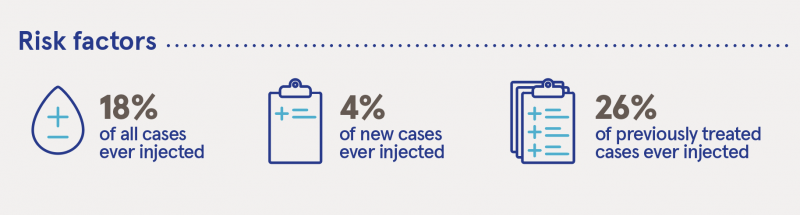
In 2025, 17.7% of cases reported that they had ever injected. Most of those were previously treated cases (89.9%). Among cases reporting ever injecting, 27.8% were currently injecting (i.e. in the 30 days prior to treatment).
The proportion of cases reporting injecting has declined in the long term, from 29.7% in 2017 and from 18.7% in 2024
- Opioids were the most common main drug among cases currently injecting (76.7%), followed by cocaine
- Cocaine as a main problem drug has increased from 3.7% of cases currently injecting in 2017 to 10.1% of cases currently injecting in 2025
- In 2025, 34.8% of cases who had ever injected also reported sharing needles and syringes, compared with 40.3% in 2024.
- Among cases currently injecting in 2025, 12.1% shared needles and syringes in the 30 days prior to starting treatment
- Since recording of information on sharing needles and syringes began in 2019, the proportion of cases reporting sharing has declined from 37.2% in 2019 to 34.8% in 2025
1 Tierney P, Lynch T, O’Sullivan M and Carew AM (2026) National Drug Treatment Reporting System, 2025 Drug Treatment Demand. HRhttps://www.hrb.ie/publication/drug-treatment-demand-in-ireland-B StatLink Series 30. Dublin: Health Research Board. Available from: https://www.drugsandalcohol.ie/45416/
B Substances > Alcohol
B Substances > Cocaine
B Substances > New (novel) psychoactive substances > Benzodiazepines
HJ Treatment or recovery method > Substance disorder treatment method
J Health care, prevention, harm reduction and treatment > Treatment and maintenance > Treatment factors
VA Geographic area > Europe > Ireland
VA Geographic area > Europe > Ireland > County / regional data
Repository Staff Only: item control page