
Doyle, Anne  ORCID: https://orcid.org/0000-0002-2776-3476 and Mongan, Deirdre ORCID: https://orcid.org/0000-0003-3616-4253
(2026)
Understanding per capita alcohol use versus low-risk drinking guidelines.
Drugnet Ireland,
Issue 95, July 2026,
pp. 30-33.
ORCID: https://orcid.org/0000-0002-2776-3476 and Mongan, Deirdre ORCID: https://orcid.org/0000-0003-3616-4253
(2026)
Understanding per capita alcohol use versus low-risk drinking guidelines.
Drugnet Ireland,
Issue 95, July 2026,
pp. 30-33.
| Preview | Title | Contact |
|---|---|---|
|
PDF (Drugnet Ireland 95)
3MB |
Introduction
Globally, alcohol use is quantified and compared across countries by determining the alcohol per capita (APC) use of a country and measuring against alcohol-related harms. Monitoring APC allows countries to assess public health, make international comparisons, track trends over time, and evaluate the impact of policies.
Defining per capita alcohol use
APC estimates are constructed by determining the amount of alcohol sold, expressed as litres of pure (100%) alcohol, within a country or region per year and applying the amount to the population aged 15 years and over (as this is typically the age at which young people start drinking alcohol). As a result, we end up with the litres of pure alcohol sold per person per year and these are used as a proxy for consumption.
In Ireland, alcohol sales are derived from Revenue excise receipts and volumes which itemise the amount of each type of beverage sold within a given year.1 Revenue data are provided as total sales of beverage type and in either hectolitres or litres. Table 1 provides an overview of how each beverage is grouped and how the number of litres of pure alcohol is calculated.
Table 1: Calculating litres of pure alcohol
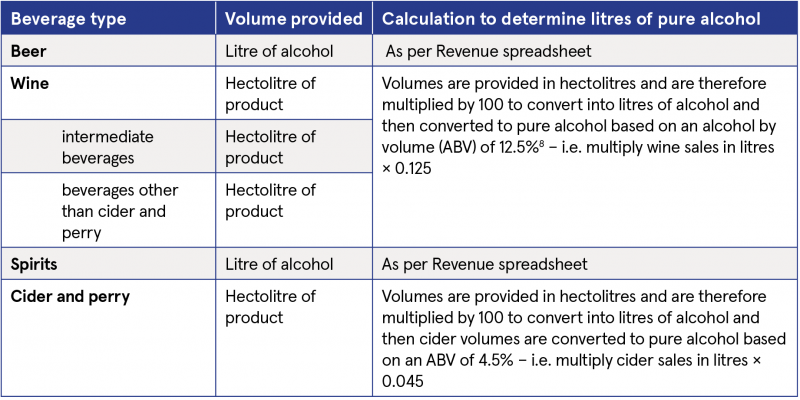
Once the total litres of alcohol are determined (as per Table 1), the next step is to examine the population. The last Census was conducted in 2022 in Ireland and each year population figures are based on estimates and updated annually.2 The population of those aged 15 years and over is calculated from these Central Statistics Office (CSO) population estimates. The total litres are then divided into the total population 15 years and over to determine per capita alcohol use (Figure 1).

Figure 1: Calculation to determine per capita alcohol use
Strengths and weaknesses of per capita alcohol use calculations
Using Revenue excise volumes represents the ‘gold standard’ of calculating and reporting per capita alcohol use as the data are complete coverage, and are consistently reported, offering trend reliability.3,4 However, they are not without limitations. Excise volumes do not include alcohol consumed by Irish people abroad, cross-border trade, or home-brewed or illicit alcohol products.5 Neither do they provide information on the prevalence of alcohol use, patterns of consumption across different demographic groups, or variation in drinking behaviour within the population. Such information is essential for understanding alcohol-related harm, including disease burden and mortality.6
APC also masks important differences within the population. Healthy Ireland Survey data indicate that 29% of people do not drink alcohol and when these non-drinkers are excluded, estimated consumption among drinkers rises substantially to 13.01 litres per capita.
Per capita alcohol use Ireland – trends over time
In 2025, using the calculations outlined here, per capita alcohol use was 9.24 litres, representing a 2% decline in per capita alcohol use since 2024 (9.43 litres) and a 16.1% decline since the introduction of the Public Health (Alcohol) Act in 2018.
Despite declining APC, Ireland remains above both the Organisation for Economic Co-operation and Development (OECD) average (8.5 litres) and the Government target of 9.1 litres per capita, originally set in 2013 and to be achieved by 2020.
Ultimately, while APC and survey data are valuable indicators, their findings should be interpreted with caution, considering underlying assumptions, data limitations, and population-level variations.
Individual low-risk drinking guidelines
While per capita consumption describes overall population use, it should not be interpreted as a guide to individual drinking risk. The HSE acknowledges that there is ‘no level of alcohol use that is safe for health’.7 However, it provides guidelines for drinkers aged 18 years and over on ‘low-risk’ thresholds to reduce the risk of alcohol-related harm. Of note, children aged under 18 years and pregnant women or women planning a pregnancy should not consume alcohol. Current weekly low-risk alcohol guidelines for drinkers aged 18 years and over are:
- No more than 11 standard drinks* per week, if you are a woman
- No more than 17 standard drinks per week, if you are a man
The HSE advises that drinks should be spread out across the week, that drinkers should have at least 2 to 3 alcohol-free days per week and not to drink more than 6 standard drinks on any one occasion.
If every adult drinker in Ireland consumed the maximum low-risk guidelines
Based on the HSE low-risk guidelines, if every drinker drank this maximum limit every week of the year, a man would drink 11.05 litres pure alcohol per year (i.e. 17×12.5 mL=212.5 mL pure alcohol/week × 52 weeks = 11,050 mL or 11.05 litres). For females, it would equate to 7.15 litres pure alcohol per year (i.e. 11 × 12.5 mL = 137.5 mL pure alcohol/week × 52 weeks = 7,150 mL or 7.15 litres). For both sexes, this equates to 9.1 litres pure alcohol per year (i.e.11.05 + 7.15/2 = 9.1).
Therefore, if all the drinkers in Ireland restricted their drinking to this maximum limit, the average drinker would consume 9.1 litres pure alcohol per year, well below the 13.01 litres per capita calculated for drinkers only.
*In Ireland, a standard drink has 10 g or 12.5 ml of pure alcohol.
Lower-risk drinking guidelines and the ‘no safe level’ message: Finding a balance in risk communication
An editorial in Addiction comments on the potential for confusion for drinkers distinguishing between low-risk guidelines and the ‘no safe level’ of alcohol use guidance.8 The authors point out that the ‘no safe level’ message refers specifically to the absence of a biologically risk-free threshold for certain harms, particularly cancer, while ‘low-risk’ drinking guidelines provide pragmatic advice on consumption levels associated with relatively low overall risk. Although both are well established, their relationship is often unclear, and ‘no safe level’ can be mistaken as a strict call for abstinence rather than a narrow scientific statement. Evidence suggests that such messages may raise awareness but can also trigger defensive reactions or be seen as unrealistic, especially when people already are indifferent to drinking guidelines. The authors suggest that clearer communication is needed in order to explain how these messages complement rather than contradict each other, thus ensuring credibility and helping people make informed decisions about alcohol use.
Conclusion
APC, a population-level measure, differs from low-risk drinking guidelines, which are designed for individual behaviour and are not interchangeable with per capita estimates. Low-risk drinking guidelines provide a framework for communicating the potential risks associated with alcohol consumption at the individual level.
1 Revenue Commissioiners (2022) Excise receipts by commodity. Dublin: Office of the Revenue Commissioners. Available from:
https://www.revenue.ie/en/corporate/information-about-revenue/statistics/excise/receipts-volume-and-price/excise-receipts-commodity.aspx
2 Central Statistics Office (2022) Census of Population 2022 - Summary Results. Available from:
https://www.cso.ie/en/statistics/population/censusofpopulation2022/censusofpopulation2022-summaryresults/ (accessed 4 Jul 2023).
3 Kilian C, Manthey J, Probst C, et al. (2020) Why is per capita consumption underestimated in alcohol surveys? Results from 39 surveys in 23 European countries. Alcohol Alcohol. Available from https://www.drugsandalcohol.ie/32125/
4 Gmel G and Rehm J. Measuring alcohol consumption. Contemp. Drug Probl. 2004;31:467–540.
5 Manthey J, Braddick F, López-Pelayo H, Shield K, Rehm J and Kilian C (2023) Unrecorded alcohol use in 33 European countries: analyses of a comparative survey with 49,000 people who use alcohol. Int. J. Drug Policy 2023;116:104028. Available from: https://www.drugsandalcohol.ie/38718/
6 Bhattacharya A, Angus C, Pryce R, Holmes J, Brennan A, and Meier PS (2018) How dependent is the alcohol industry on heavy drinking in England? Addict. 2018;113:2225–32.
7 Health Service Executive. Weekly low-risk alcohol guidelines. Available from:
https://www2.hse.ie/living-well/alcohol/health/improve-your-health/weekly-low-risk-alcohol-guidelines/ (accessed 10 Oct 2022).
8 Nicholls J (2026) Lower risk drinking guidelines and the ‘no safe level’message: Finding a balance in risk communication. Addict.
B Substances > Alcohol
G Health and disease > Public health
J Health care, prevention, harm reduction and treatment > Risk and protective factors
J Health care, prevention, harm reduction and treatment > Prevention approach > Prevention through information and education
J Health care, prevention, harm reduction and treatment > Health related issues > Health information and education
N Communication, information and education > Information use and impact
VA Geographic area > Europe > Ireland
Repository Staff Only: item control page