
Dowling-Cullen, Cian and O'Loughlin, Mark (2026) Information sources to inform the Irish drug early warning system: findings from a Nominal Group Technique workshop. Drugnet Ireland, Issue 95, July 2026, pp. 26-30.
| Preview | Title | Contact |
|---|---|---|
|
PDF (Drugnet Ireland 95)
3MB |
Background
Drug early warning systems (EWSs) aim to identify emerging drug-related issues early so that timely action can be taken to reduce risks to public health.1 The effectiveness of an EWS depends on the range and quality of information sources available to it. These sources may include laboratory analysis of samples obtained from a variety of settings, as well as non-laboratory information sources. Laboratory samples may be obtained from drug seizures, drug checking services, post-mortem testing, wastewater monitoring, clinical toxicology, and other settings.1,2 Non-laboratory information sources may include healthcare data on drug use and harms, law enforcement data, poison centre data, pharmacovigilance system data, and reports from key informants (including people who use drugs and staff working in health and social care, outreach, and harm reduction settings).1,2
In Ireland, the Early Warning and Emerging Trends (EWET) network performs several functions related to drug EWS activities. Recent changes in drug use patterns in Ireland have highlighted the need for a practical, responsive, and robust EWS to detect emerging risks and protect public health.3 A key step in developing this capacity involves understanding and prioritising the information sources available, and identifying the barriers that may impact their inclusion in an Irish EWS.
- To this end, the authors conducted a structured workshop with Irish stakeholders to:
- Identify information sources perceived to be particularly important for an Irish EWS
- Describe the characteristics that should be considered when assessing these sources
- Identify information-related barriers to the implementation of an effective drug EWS in Ireland
Methods
A Nominal Group Technique (NGT) workshop was arranged with key Irish drug EWS stakeholders. NGT is a structured means to obtain qualitative information from a group of participants.4 The workshop was two hours in duration and was held in person at the HRB in Dublin in February 2025. One representative from each organisation on the EWET committee was invited to attend. The workshop addressed three specific questions:
- What existing information sources in Ireland should be considered for inclusion in an Irish drug EWS?
- What aspects of these information sources should we collect further information on, in order to assess their potential for inclusion in an Irish drug EWS?
- Overall, what are the main information-related barriers or gaps that need to be addressed in order to establish an effective drug EWS in Ireland at present?
In advance of the session, the group was provided with a brief summary of the project and the three questions. A structured approach was adopted, as outlined in published literature,4,5 whereby participants initially shared their own ideas, followed by discussion and voting to prioritise the list of ideas or answers for each of the three questions posed.
Results
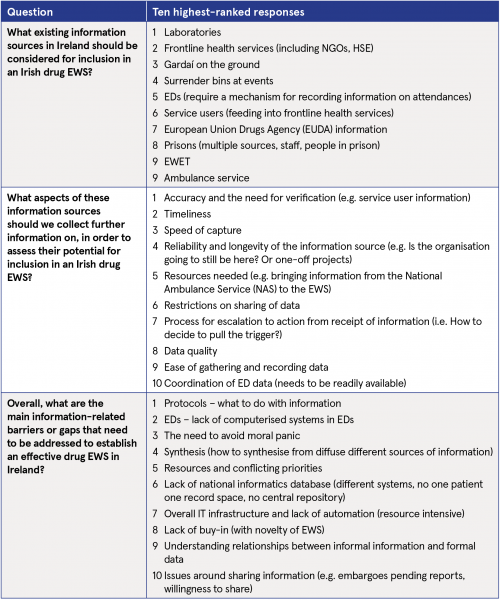
A total of 11 participants were involved. This included representation from Health Service Executive (HSE) Addiction Services, the HRB, the National Drug Treatment Centre Laboratory, Forensic Science Ireland, the Irish Prison Service, the Garda National Drugs and Organised Crime Bureau, the Medical Bureau of Road Safety, and the Ana Liffey Drug Project. The ten most highly ranked answers for each question are shown in Table 1. The key findings relating to each of the workshop questions are summarised below.
Workshop question 1 – What existing information sources in Ireland should be considered for inclusion in an Irish drug EWS?
When asked to identify which existing information sources should be considered for inclusion in a national drug EWS, participants placed the greatest importance on laboratory analyses. Frontline health services, encompassing both HSE and non-governmental organisations (NGOs), and frontline Garda reports, were the next highest ranked. Other sources reported to be important included event surrender bins and emergency department (ED) data. Service user information obtained through health service interactions and notifications from the European Union Drugs Agency (EUDA) early warning system also featured prominently.
Workshop question 2 – What aspects of these information sources should we collect further information on, in order to assess their potential for inclusion in an Irish drug EWS?
When discussing the characteristics by which these sources should be appraised, accuracy and the need for verification were ranked highest, followed by timeliness, speed of capture, and data availability. Participants further highlighted the reliability and longevity of the source, and the resources required to integrate each source into the system. Additional considerations included the clarity of data-sharing restrictions, the existence of a defined process for escalation to actions to protect public health, and overall data quality issues.
Workshop question 3 – Overall, what are the main information-related barriers or gaps that need to be addressed to establish an effective drug EWS in Ireland at present?
In relation to information-related barriers or gaps, the absence of standardised protocols for handling early warning information was the highest-ranked issue. This was followed by the lack of comprehensive computerised systems in many EDs and the need to avoid moral panic. Participants also cited the issue of reconciling disparate data sources, resource and prioritisation challenges across agencies, the absence of a national informatics database, and other IT system challenges.
Conclusion
This workshop provides an initial structured assessment of potentially important data sources and characteristics to consider for an Irish drug EWS, alongside practical barriers to implementation. Participants prioritised laboratory analyses, frontline health service and Garda reports, event surrender bins, and ED data. They identified accuracy, timeliness, reliability, and resource requirements as key criteria for assessing potential sources. Participants also highlighted key challenges in the Irish context at present, such as the need for formal procedures for handling early warning data and the need for appropriate IT systems to enable EWS reporting in various settings, including EDs. Limitations of the NGT workshop included its brief duration and the fact that stakeholders were primarily national-level professionals, with limited inclusion of community-based organisations or individuals with lived experience of drug use. Overall, the findings present an initial framework to help guide further research and decision-making regarding the optimal structure and processes for the development of Ireland’s drug EWS.
Table 1: Highest-ranked responses for each NGT workshop question. Responses are recorded in the participants’ own words.
1 Cooperation Programme between Latin America, the Caribbean and the European Union on Drugs Policies (COPOLAD II) (2020). Early warning system on new psychoactive substances and emerging drug phenomena – implementation manual. Madrid: International and Ibero-American Foundation for Administration and Public Policies; Government Delegation for the National Plan on Drugs.
2 European Monitoring Centre for Drugs and Drug Addiction (2019). EMCDDA operating guidelines for the European Union Early Warning System on new psychoactive substances. Luxembourg: Publications Office of the European Union. https://www.drugsandalcohol.ie/31486/
3 Killeen N, Mongan D, Keenan E and Galvin B (2026). Strengthening Ireland’s response to new and emerging trends within the next policy life cycle. Supplement to Drugnet 93. Dublin: Health Research Board. https://www.drugsandalcohol.ie/45271/
4 Harvey N and Holmes CA. Nominal group technique: An effective method for obtaining group consensus. Int J Nurs Pract. 2012;18(2):188–94.
5 Mullen R, Kydd A, Fleming A and McMillan L (2021). A practical guide to the systematic application of nominal group technique. Nurse Res. 2021 Mar 11;29(1):14–20.
E Concepts in biomedical areas > Pharmacology and toxicology
J Health care, prevention, harm reduction and treatment > Risk and needs assessment > Risk assessment > Early warning monitoring system
J Health care, prevention, harm reduction and treatment > Identification and screening > Identification and screening for substance use
J Health care, prevention, harm reduction and treatment > Health related issues > Health information and education
VA Geographic area > Europe > Ireland
Repository Staff Only: item control page