
Dillon, Lucy (2026) Examining tobacco control enforcement in Ireland 2014–2023. Drugnet Ireland, Issue 95, July 2026, pp. 13-15.
| Preview | Title | Contact |
|---|---|---|
|
PDF (Drugnet Ireland 95)
3MB |
Tobacco control legislation is a critical element in reducing the harms of smoking. However, it will only be effective if enforced. The Examining tobacco-control enforcement in Ireland 2014-2023: an observational study analysed data on the enforcement of the Public Health (Tobacco) Act 2002 as amended between 2014 and 2023.1 It explored the extent to which the laws have been followed, and what happens to those who break them.
Context
Despite tobacco control legislation, and various smoking prevention activities, Houghton and Lombard argue that smoking continues to impact negatively on health and well-being in Ireland. Data published in 2022 found that among those who were aged 15 years and over, 20% of males and 17% of females were current smokers.2 This is far from Ireland’s tobacco free target of a tobacco use prevalence rate below 5% by 2025.3 Furthermore, the harms caused by smoking exacerbate health inequalities. According to Houghton and Lombard, there is a ‘20 percentage point gap between those in higher managerial, administrative, and professional occupations compared to those in routine manual occupations (11% versus 31%)’ (p. 2).1 Also, to support a reduction in smoking rates, Ireland has ‘a strong track record on tobacco control measures’ (p. 2). This includes high rates of taxation, and legislation on: a workplace smoking ban, plain packaging, a ban on point-of-sale display, and a legal minimum age of 18 years to purchase tobacco products. Houghton and Lombard argue that while it is critical that such legislation is in place, it is also critical that it is enforced. Given ‘Ireland’s continuing deficits in public health enforcement’ (p. 3)1, the aim of their research was to explore the extent to which this happened in the field of tobacco. Their research aimed to explore convictions, penalties, and associated costs imposed in the period 2014–2023 under various sections of the Public Health (Tobacco) Act 2002 as amended.
Methodology
This article is based on secondary descriptive statistical analysis of tobacco conviction data released annually by the HSE’s National Environmental Health Service (NEHS) (https://www.hse.ie/eng/about/who/tobaccocontrol/enforcement/).4 Data were collected on the number and outcomes of the inspections made by the NEHS of premises where tobacco is sold. Data were analysed using descriptive statistics, including 95% confidence intervals, in SPSS (Statistical Package for the Social Sciences). The data analysed that explored the number and types of penalties under various sections of the legislation were: the number of convictions; the value of any fine incurred; costs arising from the prosecution of the offence; and the time period of removal from the Tobacco Retail Register (inclusion on which is a requirement of eligibility to be allowed to sell tobacco products in Ireland). Allowances are made in the analysis for the COVID-19 pandemic years 2020/21.
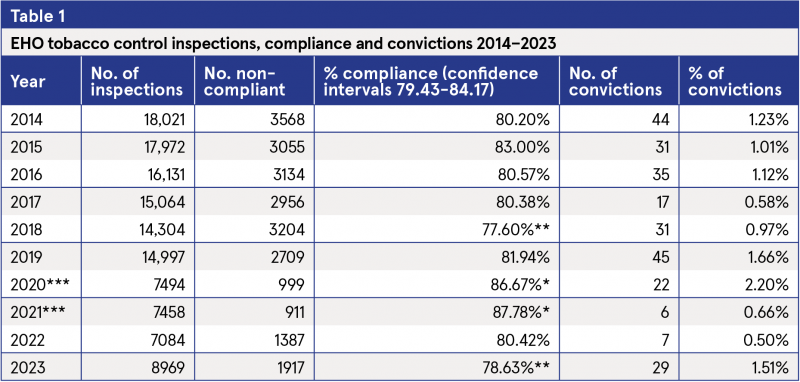
Source: Tobacco Free Ireland annual reports and annual returns on the Health Service Executive’s (HSE) National Environmental Service.
*Outside of the 95% confidence intervals (higher).
**Outside of the 95% confidence intervals (lower).
***Given the reduced number of inspections during 2020 and 2021 as a result of shutdowns resulting from the COVID-19 pandemic care should be taken in interpreting compliance rates in these years.
Findings
Some of the key findings were:
- The average annual number of inspections made of sites where tobacco products were sold over the study period was 12,794.
- Inspections were reduced in 2020 and 2021 in order to enable HSE staff to meet the demands of dealing with the COVID-19 pandemic. This number remained relatively low through 2022/23 when compared with pre-COVID-19 pandemic figures. In 2023, 8,969 inspections were carried out, compared with 14,997 inspections in 2019.
- The average annual number of inspections that identified evidence of non-compliance with the legislation for the study period was 2,384.
- Apart from 2020/21, the compliance rate was consistent at in and around 80% of all inspections.
- Only 1.12% of instances of non-compliance between 2014 and 2023 resulted in conviction under the legislation.
- Where convictions were achieved, the penalties invoked, at judicial discretion, were routinely far below the maximum possible under the Acts. In total, 93.1% of fines and 85.5% of costs charged were for sums of €1,500 or less. Where a ban from selling tobacco was imposed, it was a 1-day ban or less in 56.9% of convictions, and a 30-day or more ban in 6.9% of cases.
- Convictions for some sections of the Act between 2014 and 2023 were minimal. For example, Section 46 (display of signs) had eight convictions, and Section 48 (interference with an Environmental Health Officer carrying out their duties) had two.
- Section 37 (being registered on the Tobacco Register) had 18 convictions and, Section 43 (vending machines) had 20.
- The sections under which most convictions were made were Section 47 (smoking in workplaces and the conformity of shelters) which had 113, and Section 45 (underage/test purchases) which had 106.
Discussion
In their discussion, Houghton and Lombard reflect on the consistent compliance rate of approximately 80%, and that there is no indication of improvements in this rate. They argue that enforcement of this legislation should be as close to 100% as possible. The findings suggest that while ‘research on Environmental Health Officer enforcement in Ireland has noted a partiality towards soft mandates instead of sanctions’ (p. 7), this is not enough to attain a higher compliance rate. Based on their findings, they make recommendations, including:
- The introduction of fixed charge notices whereby fines are issued automatically at a fixed rate for non-compliance.
- Tobacco control advocates need to focus not only on developing improved legislation but also the implementation and enforcement of existing legislation.
- Conviction rates for non-compliance ought to be raised. There needs to be a better understanding of existing data – for example, whether there exist special variations in the data.
- Qualitative research is required in order to explore the decision-making that happens between an EHO finding an instance of non-compliance and the decision to issue a summons. Houghton and Lombard describe this as a ‘black box’ (p. 7).
Concluding comment
Houghton and Lombard’s paper discusses how the low level of enforcement and minimal penalties imposed undermine tobacco control in Ireland. It highlights the need for further research in the field of this and similar legislation in the Irish context – for example, under the Public Health (Alcohol) Act 2018.
1 Houghton F and Lombard J (2025) Examining tobacco-control enforcement in Ireland 2014-2023: an observational study. Perspect. Public Health, Early online, https://doi.org/10.1177/17579139251371974. Available from: https://www.drugsandalcohol.ie/44365/
2 The State of Tobacco Control in Ireland. HSE Tobacco Free Ireland Programme. Second Report. Dublin: HSE, 2022. Available from: https://www.drugsandalcohol.ie/36370/
3 Tobacco Free Ireland. Annual Report 2022. Dublin: Tobacco Free Ireland, 2022. Available from: https://www.drugsandalcohol.ie/40262/
4 HSE (2024). Compliance and Enforcement. Available online at: https://www.hse.ie/eng/about/who/tobaccocontrol/enforcement/ (accessed by Houghton and Lombard on 22 Aug 2024).
Repository Staff Only: item control page