
Millar, Seán R  ORCID: https://orcid.org/0000-0003-4453-8446
(2026)
Self-harm in Irish prisons, 2024.
Drugnet Ireland,
Issue 94, April 2026,
pp. 23-24.
ORCID: https://orcid.org/0000-0003-4453-8446
(2026)
Self-harm in Irish prisons, 2024.
Drugnet Ireland,
Issue 94, April 2026,
pp. 23-24.
| Preview | Title | Contact |
|---|---|---|
|
PDF (Drugnet Ireland 94)
1MB |
The Self-Harm Assessment and Data Analysis (SADA) Project was set up in Ireland in 2016 to provide robust information relating to the incidence and profile of self-harm within prison settings, as well as individual-specific and context-specific risk factors relating to self-harm. In addition, it examines patterns of repeat self-harm (both non-fatal and fatal). The HSE's National Office for Suicide Prevention and the National Suicide Research Foundation assist the Irish Prison Service with data management, data analysis, and reporting.
This article highlights findings from a report presenting data in the analysis of all episodes of self-harm across the Irish prison estate during 2024.1
Episodes of self-harm
Between 1 January and 31 December 2024, there were 203 episodes of self-harm recorded in Irish prisons, involving 142 individuals. The majority of prisoners who engaged in self-harm were male (85.9%), but taking into account the male prison population, the rate of self-harm among males was 2.9 per 100 prisoners. Twenty female prisoners engaged in self-harm in 2024, equating to a rate of 12.7 per 100 prisoners, which is higher than the rate among male prisoners.
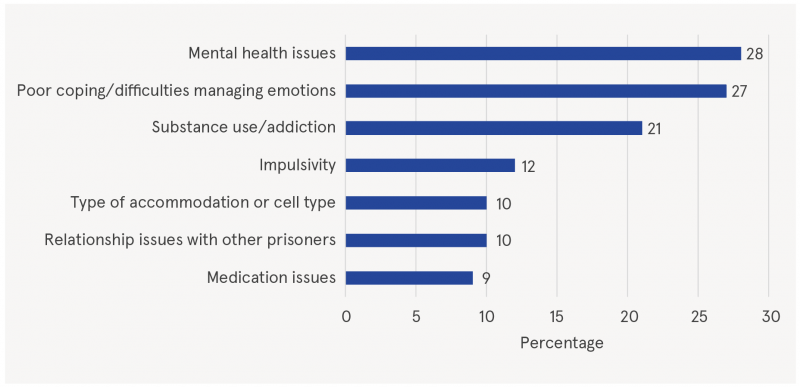
Source: Irish Prison Service, National Office for Suicide Prevention, National Suicide Research Foundation (2025)
Figure 1: Most common contributory factors to self-harm in Irish prisons, 2024
Methods, severity, and intent
The most common method of self-harm recorded was self-cutting, which was present in 65.0% of all episodes. The other common method of self-harm was attempted hanging, which was involved in 14.4% of episodes. Intentional overdose was reported in 3.4% of all episodes. In 32.5% of self-harm episodes, no medical treatment was required, while 40.9% of all episodes required minimal intervention/minor dressings or local wound management. Outpatient or Emergency Department treatment was required in 10.3% of cases, and 1.0% of episodes resulted in hospitalisation. Three self-harm incidents (1.5%) resulted in loss of life.
Contributory factors
The most common contributory factors to self-harm are shown in Figure 1. The majority of contributory factors recorded related to mental health issues (28%). Substance misuse, including drug use and drug seeking, was the third most common factor recorded (21%).
Other findings
Other findings highlighted in the report include the following:
- Nearly one in five individuals who engaged in self-harm did so on more than one occasion, and females had slightly higher repetition rates than males.
- Repeat self-harmers accounted for a disproportionate share of the total number of episodes.
- In line with findings from previous reports, substance misuse continues to be one of the primary factors associated with self-harm among the prison population in Ireland.
1 Irish Prison Service, National Office for Suicide Prevention, National Suicide Research Foundation (2025) Self-harm in Irish prisons 2024 report. Sixth report from the Self-Harm Assessment and Data Analysis (SADA) Project. Dublin: Irish Prison Service. Available from: https://www.drugsandalcohol.ie/45031/
F Concepts in psychology > Behaviour > Self-destructive behaviour / self-harm
G Health and disease > Substance use disorder (addiction)
G Health and disease > Substance use disorder (addiction) > Drug use disorder > Drug intoxication > Poisoning (overdose)
J Health care, prevention, harm reduction and treatment > Health care programme, service or facility > Prison-based health service
MM-MO Crime and law > Justice system > Correctional system and facility > Prison
T Demographic characteristics > Person in prison (prisoner)
VA Geographic area > Europe > Ireland
Repository Staff Only: item control page